SEO Mind Map: Build Topical Authority in 2026

An SEO mind map is a visual content planning system that organizes your website around a core topic, then branches into subtopics, question pages, and supporting content, all connected through strategic internal links. Instead of publishing random blog posts and hoping they rank, you're building what Google actually rewards: a structured body of knowledge that proves you understand a subject deeply. The difference shows up fast. Sites using topical mapping see clearer rankings because search engines can finally understand what you're about.
Most content strategies fail because they treat every keyword as a separate target. You end up with 50 disconnected articles that compete against each other instead of supporting a unified authority. In practice, the strongest SEO strategies in 2026 start with a single pillar page, then expand into tightly clustered content that answers specific user questions. Each piece links back to the core, creating a hierarchy that both readers and algorithms can follow. This isn't theory, agencies managing high-traffic sites use this exact Content Pillar Strategy to dominate competitive niches.
This guide walks you through building your own SEO mind map from scratch. You'll learn how to choose a core topic, cluster keywords by intent, design internal link structures before you publish, and audit your map as search behavior changes. No guesswork, no content waste, just a repeatable system for building topical authority that actually ranks.
Table of Contents
Why Traditional Keyword Research is Leaving Your Rankings in the Dark
Traditional keyword research follows a predictable pattern: you fire up a tool, export a spreadsheet of search volumes, pick a few targets, and start writing. The problem? This linear approach ignores how Google actually evaluates content in 2026. Search algorithms don't reward isolated articles that target single keywords anymore, they reward comprehensive topical coverage that demonstrates genuine expertise across an entire subject area.
When you chase individual keywords without understanding how they connect, you end up with scattered content that confuses both readers and search engines. Your site becomes a collection of unrelated articles rather than a cohesive knowledge base. Google's algorithms are designed to identify sites that cover topics thoroughly, not just sites that mention keywords frequently. According to TopRank Marketing, topical mapping centers on a core theme with branching subtopics, creating a structured body of content that demonstrates knowledge across a subject area rather than isolated keyword targeting.
The real frustration shows up when you publish what seems like solid content, but your rankings stagnate. You're not ranking because you haven't shown Google that you understand the full context around your topic. Competitors who map their content strategy visually, connecting core concepts to supporting subtopics, build what search engines recognize as topical authority. They're not necessarily writing more content; they're writing smarter content that fits into a clear hierarchy.
Traditional keyword lists also miss the semantic relationships between search queries. When someone searches "hard to find keywords," they're often also interested in keyword clustering, search intent mapping, and competitive gap analysis. A spreadsheet can't show you these connections. Without an SEO Mind Map to visualize how topics relate to each other, you'll keep creating content that overlaps, competes with itself, or leaves critical gaps in your coverage. That's why planning is slow and results are unpredictable, you're working without a map.
How to Build Topical Authority Using a Visual Content Pillar Strategy
Building topical authority starts with a shift in perspective. Instead of asking "what keywords should I target?" you need to ask "what complete understanding does my audience need?" An SEO Mind Map answers that question by showing you the full landscape of a topic before you write a single word. This visual approach transforms content planning from guesswork into strategic architecture.
Identifying Your Core Pillars and Semantic Clusters
Your core pillar is the central topic you want to own, broad enough to build depth around, but narrow enough to actually dominate. For an accounting software company, "small business accounting" works better than "accounting" (too broad) or "invoice templates for freelancers" (too narrow). Start by choosing one pillar that aligns with your business goals and has clear commercial value.
Once you've defined your core pillar, branch out into semantic clusters, groups of related subtopics that support and expand on the main concept. These aren't just related keywords; they're distinct aspects of the topic that users actually care about. For small business accounting, your clusters might include tax preparation, expense tracking, payroll management, and financial reporting. Each cluster becomes its own content hub.
The key is grouping keywords by intent and semantic relationship, not just search volume. Keyword Insights emphasizes mapping the full topic universe, then clustering keywords into content pieces using SERP-based grouping rather than treating every keyword as an isolated target. This prevents scattered content and improves precision.
Within each cluster, identify the specific questions and pain points your audience has. "Tax preparation" isn't just one article, it might include quarterly tax deadlines, deductible expenses, tax software comparisons, and year-end checklists. A good mind map shows these relationships visually, making it obvious where you need content and where you're already covered. This structure also prevents keyword cannibalization because each page has a clearly defined scope and intent.
Mapping Long-Tail Variations to User Intent
Long-tail keywords aren't just longer phrases, they're specific expressions of user intent at different stages of the search journey. Someone searching "accounting software" is browsing options. Someone searching "how to categorize business expenses in QuickBooks" has a specific problem they need solved right now. Your content pillar strategy needs to address both, but they require different page types and different treatment.
Map each long-tail variation to one of four intent categories: informational (learning), navigational (finding a specific page), commercial (comparing options), or transactional (ready to buy). This prevents you from writing three different articles that all target the same intent with slightly different keywords. Instead, you create one comprehensive piece that satisfies the full intent and naturally incorporates related variations.
Real-world Example: For example, "best accounting software for small business," "top small business accounting tools," and "accounting software comparison" all share commercial investigation intent. They belong on the same comparison page, not three separate articles. A visual mind map makes these overlaps obvious before you waste resources creating duplicate content.
The Content Pillar Strategy works because it mirrors how people actually think about topics. They don't compartmentalize information into isolated keywords, they build mental models with core concepts and supporting details. When your content structure matches that mental model, users find what they need faster, stay on your site longer, and trust your expertise more. Google's algorithms detect these engagement signals and reward sites that provide comprehensive, well-organized information.
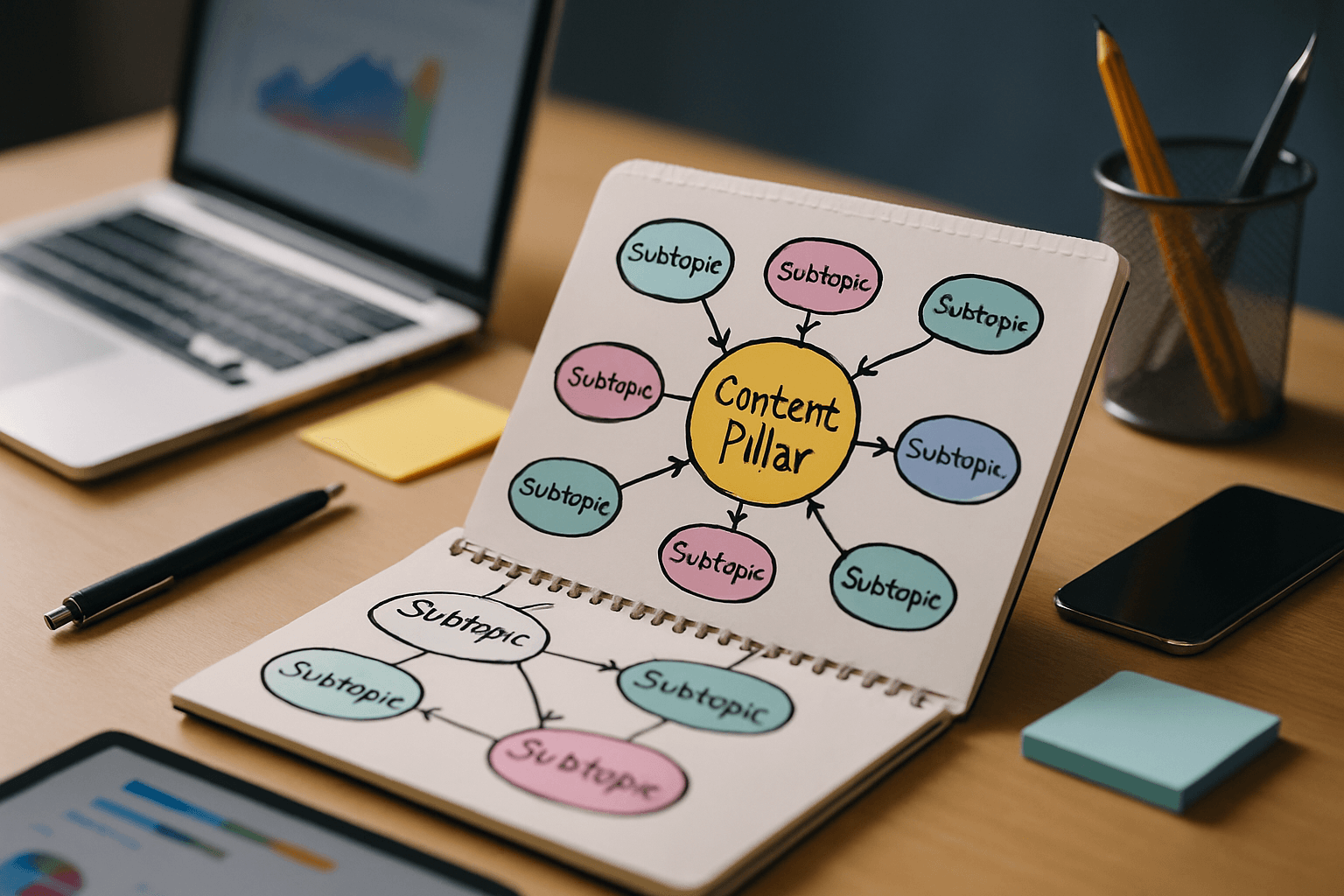
Bridging the Gap Between Visualization and Execution
Creating a beautiful mind map is satisfying, but it's worthless if it stays in a diagram. The real power comes from translating your visual strategy into a concrete execution plan with specific page assignments, internal linking architecture, and content briefs. This is where most teams struggle, they plan a solid Content Pillar Strategy well but execute inconsistently.
Start by assigning each node in your SEO Mind Map a page type: pillar page, cluster guide, comparison article, FAQ page, or case study. Your main pillar becomes a comprehensive guide (think 3,000+ words) that covers the core topic at a high level and links out to every cluster. Each cluster page dives deeper into its specific subtopic and links back to the pillar and to related clusters. This creates what's called a content silo structure, a clear hierarchy that search engines can easily understand.
Internal linking is not optional decoration; it's the infrastructure that makes topical authority work. Before you publish anything, design your link structure. The pillar should link to all clusters. Clusters should link back to the pillar and to related clusters where the connection makes sense for readers. Supporting articles should link to their parent cluster and pillar. This intentional linking distributes authority throughout your topic and helps search engines understand which pages are most important.
Finally, build content briefs that maintain consistency across your entire topical map. Each brief should specify the target intent, primary semantic cluster, required internal links, and key questions to answer. This ensures that whether you're writing the content yourself, working with freelancers, or using automation tools, every piece fits into your larger strategy. According to InLinks, building topical authority requires a structured body of content that demonstrates knowledge across a subject area, which means every piece needs to contribute to the whole rather than standing alone.
Scaling Your Strategy with SEO Workflow Automation
Building a comprehensive topical map is one challenge. Executing it consistently across dozens or hundreds of articles is another entirely. Manual content production creates bottlenecks: research takes hours, briefing writers requires detailed communication, maintaining quality across multiple contributors is exhausting, and keeping track of what's published versus what's planned becomes its own job. SEO Workflow Automation solves these problems by turning your SEO Mind Map into a production system.
The transformation happens when you stop thinking about content creation as a series of individual tasks and start treating it as a repeatable workflow. SEO Workflow Automation handles the mechanical parts, keyword clustering, content brief generation, draft creation, and even publishing, while you focus on strategy and quality control. This isn't about replacing human judgment; it's about removing the tedious work that slows down execution.
For business owners who don't have SEO expertise, automation provides an end-to-end system that runs with minimal input. You define your core business topics, and the system maps out the content strategy, generates articles optimized for Google's E-E-A-T guidelines, and publishes directly to your WordPress site. You get the benefits of a comprehensive Content Pillar Strategy without needing to understand semantic SEO strategy or internal linking for seo architecture. The system handles niche authority building by ensuring consistent coverage across your chosen topics.
SEO specialists and agencies need something different, they want control and precision, not a black box. Advanced automation tools like SEO Siah software provide modular workflows where you can adjust every parameter: customize the SEO Mind Map structure, fine-tune keyword clusters, modify content templates, and set specific internal linking rules. This turns automation into a power tool that accelerates your workflow rather than constraining it. You can handle more clients simultaneously because the system manages the production details while you focus on strategic decisions and client relationships.
Agencies face a particular challenge: maintaining quality consistency across multiple writers, clients, and topics. An automated SEO engine solves this by standardizing the production process. Every article follows the same research methodology, uses the same E-E-A-T optimization principles, and integrates into the pillar–cluster structure correctly. You're not hoping that Writer A understands topical authority as well as Writer B, the system enforces best practices automatically. This consistency is what allows agencies to scale from 10 clients to 100 without proportionally increasing their team size.
The most powerful aspect of automation is bulk generation within a strategic framework. Once you've validated your topical map, you can generate entire content clusters simultaneously rather than one article at a time. The system maintains the semantic relationships, ensures proper internal linking, and keeps every piece aligned with the overall strategy. What used to take months of coordinated effort now happens in days. You can respond to market changes faster, test new topic areas without massive resource commitments, and actually achieve the comprehensive coverage that a strong Content Pillar Strategy requires.
Competitor keyword analysis becomes continuous rather than a one-time project. Automated systems can monitor what topics your competitors are covering, identify gaps in your own content, and suggest expansions to your topical map. This keeps your Content Pillar Strategy dynamic and responsive. You're not locked into a static plan created six months ago, you're adapting as search trends and competitive landscapes shift.
The reality of SEO in 2026 is that comprehensive topical coverage is table stakes for competitive niches. You can't win by publishing five great articles a year. You need dozens of strategically connected pieces that demonstrate genuine expertise across your subject area. Manual processes simply can't keep pace with that demand while maintaining quality. SEO Workflow Automation isn't about cutting corners; it's about making ambitious content strategies actually achievable. When your workflow can execute as fast as your strategy can plan, you stop leaving rankings on the table due to execution bottlenecks.
Common SEO Mind Mapping Mistakes and How to Fix Them
| Mistake | Why It Hurts Your Strategy | How to Fix It |
|---|---|---|
| Trying to cover everything | Dilutes focus and makes it harder to establish authority in any specific area | Choose a core topic narrow enough to own but broad enough to build depth around |
| Ignoring search intent | Mixing informational, transactional, and navigational content randomly confuses users and search engines | Assign one main intent per page and group content by user goals |
| Keyword cannibalization | Multiple pages targeting the same intent compete against each other and weaken overall performance | Use keyword clustering to ensure each page targets a distinct intent or subtopic |
| Weak internal linking | Without strategic links, your topical map remains just a planning document with no SEO impact | Design internal link structure before publishing, link supporting pages to pillars and related clusters to each other |
| Static planning | Search intent and market needs evolve; outdated maps lose relevance and authority | Schedule regular audits to identify content gaps, refresh outdated pages, and expand into new subtopics |
An SEO mind map turns scattered content ideas into a clear, strategic plan that actually drives traffic. Instead of publishing random posts and hoping Google notices, you're building a connected ecosystem where every piece of content supports your broader goals. The difference shows up in your rankings within 8-12 weeks, and more importantly, in how efficiently you create content that performs.
You've seen how visual planning helps you spot gaps in your coverage, identify quick wins, and build topical authority systematically. This isn't theoretical, it's how agencies manage dozens of clients without losing track of each site's unique strategy. When you map your content universe before you write, you avoid duplicate topics, strengthen internal linking naturally, and give search engines exactly what they need to understand your expertise.
Your next move depends on your workflow. If you're managing this manually, start with one core topic and map out 8-10 related subtopics this week. If you want the structure without the hours of planning, SEO Workflow Automation through SEO Siah generates these mind maps automatically and builds the entire content cluster from there, research, writing, and publishing included.
The sites winning in 2026 aren't guessing their way through content. They're planning strategically, publishing consistently, and letting structure do the heavy lifting. Your mind map is that structure.
Related Articles
Frequently Asked Questions
Why am I not ranking despite publishing good content?
You're not ranking because you haven't shown Google that you understand the full context around your topic. Search algorithms reward comprehensive topical coverage that demonstrates genuine expertise across an entire subject area, rather than isolated articles that target single keywords.
How do I build topical authority using an SEO mind map?
Building topical authority starts by choosing a core pillar topic, then branching out into semantic clusters, groups of related subtopics that support the main concept. An SEO mind map visually organizes these clusters, ensuring you cover specific user questions and map long-tail variations to user intent.
How does SEO workflow automation help with content mapping?
SEO workflow automation turns your strategic mind map into a production system. It handles the mechanical parts like keyword clustering, content brief generation, and proper internal linking, allowing you to scale your strategy and generate entire content clusters simultaneously.