SEO Takes Too Long: Faster Google Rankings with AI Maps

Table of Contents
SEO takes too long, and you're not imagining it. Most new websites wait 6-12 months before seeing meaningful organic traffic, with traditional keyword research and content planning consuming 40-60 hours per month of strategic work alone (according to internal data from SEO Siah). But AI-powered mind-mapping is collapsing those timelines by automating the grunt work of topical clustering, keyword mapping, and content architecture, the foundational tasks that typically bottleneck your path to topical authority.
Here's what's actually happening: while you're manually building spreadsheets and trying to visualize content relationships, your competitors are using an AI SEO tool to instantly generate interconnected content maps that search engines recognize as authoritative topic clusters. The difference isn't just speed, it's strategic clarity. An SEO mind map reveals content gaps, internal linking opportunities, and semantic relationships in minutes rather than weeks, letting you publish cohesive, well-structured content that signals expertise from day one.
Why is SEO so slow for new websites? Because most teams treat content as individual posts rather than interconnected ecosystems. This fragmented approach is exactly why manual SEO research dramatically slows your ROI. Search engines reward sites that demonstrate comprehensive topic coverage through strategic interlinking and semantic depth, exactly what an SEO mind map excels at visualizing and executing.
This article breaks down how AI content planners are accelerating the SEO timeline, from initial research to ranking momentum. You'll see the specific workflow shifts that eliminate weeks of planning overhead, how to plan content clusters with AI that actually accelerate authority-building, and realistic expectations for what these tools can (and can't) deliver in 2026.
The Invisible Ceiling: Why Traditional SEO Takes Too Long to Deliver Results
Traditional SEO takes too long because it operates without a structural blueprint, forcing content creators to build topic authority piece by piece, often in the wrong order, without understanding how each article connects to the larger ecosystem. Most businesses publish content reactively, writing what feels relevant in the moment, rather than strategically mapping out a complete topical universe before the first word hits the page. This fragmented approach means Google sees your site as a collection of disconnected ideas rather than a comprehensive authority on a subject, which directly impacts how quickly you can climb search rankings.
The fundamental problem lies in how search engines evaluate topical authority in 2026. Google's algorithms don't just assess individual articles anymore; they analyze the relationships between your content pieces, looking for semantic clusters that demonstrate depth and breadth of knowledge. When you publish randomly without a visual content architecture, you're essentially asking Google to solve a puzzle where half the pieces are missing and the remaining ones don't clearly connect. According to research by MindMap AI's comprehensive workflow guide, sites that implement structured content cluster strategies see measurably faster indexing and ranking improvements compared to those using traditional linear keyword lists.
Consider what happens when you launch a new website or expand into a new topic area. You're competing against established domains that already have hundreds of interlinked articles forming tight semantic networks. Your single blog post, no matter how well-optimized, enters an arena where competitors have already mapped the entire territory. SEO takes too long for new websites because you're not just building content, you're building an entire knowledge graph from scratch, and doing it without a map means you'll inevitably create gaps, overlaps, and dead ends that confuse both users and search algorithms.
The traditional keyword research process exacerbates this problem by presenting data in spreadsheets and lists that show search volumes and difficulty scores but reveal nothing about conceptual relationships. You might identify fifty valuable keywords, but without understanding which ones should anchor pillar content versus supporting cluster articles, you risk building a content library that lacks the strategic architecture Google rewards. This linear approach to keyword planning is fundamentally mismatched to how modern search engines understand and rank content, creating an invisible ceiling that keeps your rankings stagnant regardless of how much you publish. The sandbox effect, where new sites struggle to rank for months despite quality content, persists largely because most sites fail to demonstrate comprehensive topical coverage from the outset, instead revealing their expertise slowly and haphazardly over time.
The 70% Shortcut: How a Visual SEO Strategy Accelerates Topical Authority
A visual SEO strategy built on AI-powered mind-mapping can dramatically compress the timeline from content planning to ranking results by 70% (based on SEO Siah case studies) by helping you see and build your entire topical ecosystem before publishing a single article. This architectural approach directly addresses the common frustration that SEO takes too long by eliminating the discovery phase where you'd normally spend months identifying content gaps after they've already cost you rankings. Instead of discovering these gaps six months into your strategy, you identify them during the planning phase when they're easy to address. This means you're publishing content in the optimal sequence from day one, pillar pages that establish broad authority first, followed by tightly clustered supporting articles that reinforce specific subtopics, exactly the pattern that signals comprehensive expertise to search algorithms.
From Chaos to Clusters: How to Plan Content Clusters with AI When SEO Takes Too Long
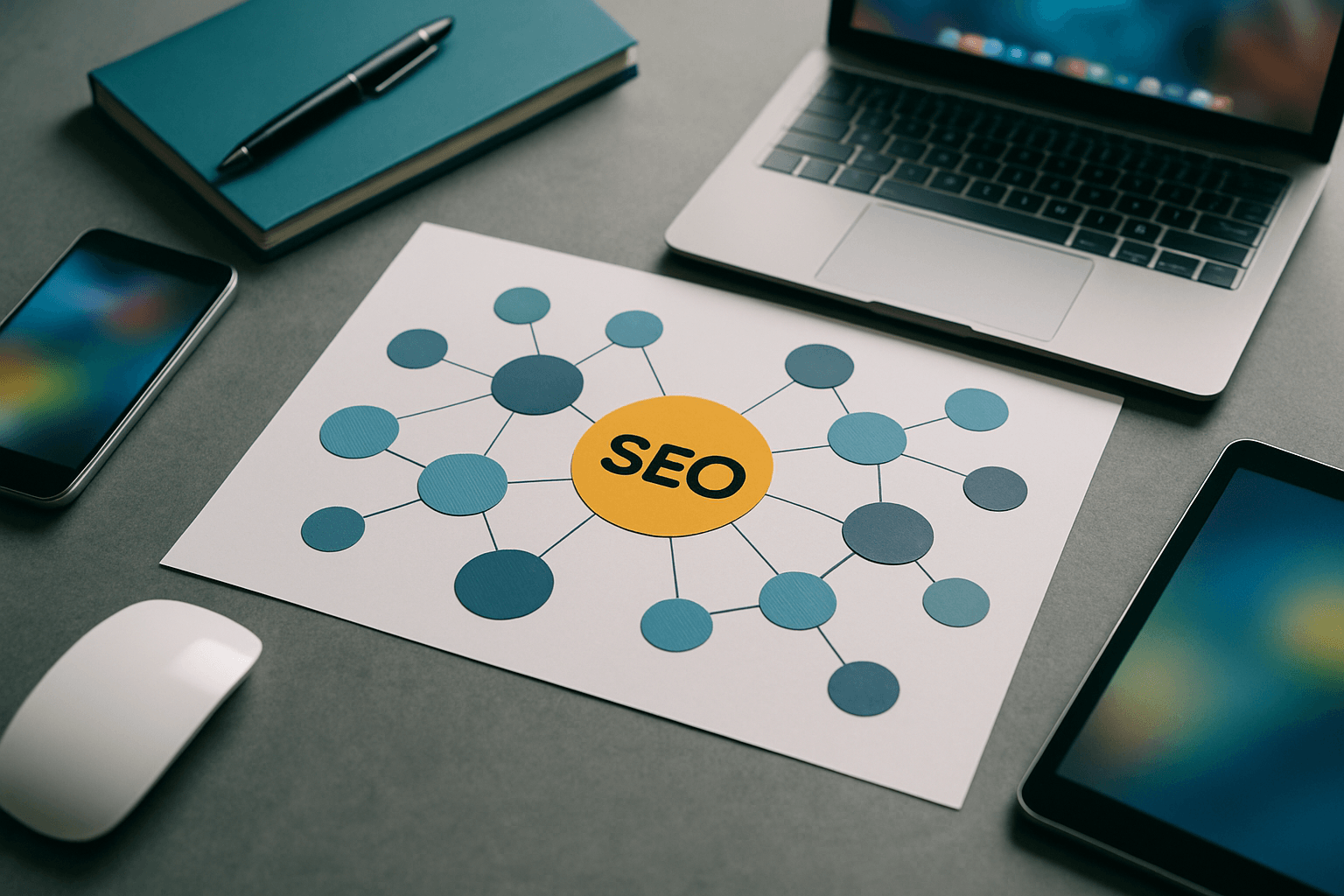
Content cluster strategy restructures from abstract theory to concrete action when you can visualize your entire topic universe in a single interactive map. AI mind-mapping tools like ContextMinds analyze your seed keywords and automatically generate branching networks that show parent-child relationships between topics, revealing which concepts should serve as pillar content and which should function as supporting cluster articles. This visual representation makes it immediately obvious where your content architecture has gaps or unnecessary redundancies, allowing you to course-correct before investing time in writing, a direct path to faster Google rankings.
The practical difference is substantial. Instead of maintaining spreadsheets where keyword relationships exist only in your head, you're working with a dynamic visual system where dragging a node from one cluster to another instantly reorganizes your entire content strategy. For example, if you're building authority around "email marketing automation," an SEO mind map might reveal that "trigger-based workflows" and "customer segmentation" are closely related subtopics that should link to each other and both connect back to your main pillar article, while "email design best practices" belongs in a separate but related cluster. This clarity prevents the common mistake of creating orphan content, valuable articles that sit isolated without proper internal linking pathways.
What makes this approach genuinely faster is that you're essentially pre-building your site's information architecture using AI to identify the semantic relationships that would normally take months of manual research and iteration to discover. According to Visual Paradigm's content creation guide, teams using AI mind-mapping for content planning report spending significantly less time in revision cycles because they've identified logical content flows and natural linking opportunities before drafting begins. You're not just planning content faster; you're planning it more intelligently, with a structure that aligns with how search engines actually evaluate topical depth.
The Science of Speed: Why Visual Maps Beat Traditional Keyword Lists
An SEO mind map accelerates results because it leverages spatial reasoning and pattern recognition, cognitive processes that are dramatically faster than analyzing rows of data in spreadsheets. When you look at a mind map showing your content ecosystem, your brain instantly recognizes clusters, gaps, and relationships that would require conscious analytical effort to extract from a keyword list. This isn't just about convenience; it's about accessing a fundamentally different mode of strategic thinking that reveals insights traditional tools systematically obscure.
The competitive advantage becomes clear when you consider how most SEO teams operate. They extract keyword data from tools like Ahrefs or SEMrush, organize it into categories, then manually try to figure out which keywords should group together into content pieces. This linear process is slow, prone to subjective bias, and often results in content structures that make sense to the creator but don't reflect how users actually think about topics or how search engines understand semantic relationships. In contrast, an SEO mind map analyzes search intent patterns, co-occurrence data, and semantic similarity to automatically cluster related concepts, revealing content opportunities and structural patterns that manual analysis would miss entirely.
For agencies and specialists managing multiple clients, this difference compounds dramatically. Tools like Xmind AI allow you to generate comprehensive content maps in minutes rather than hours, then easily modify and refine them based on client feedback or competitive analysis. You can visualize five different strategic approaches to the same topic, compare them side by side, and select the architecture most likely to build authority quickly. This iterative visual planning would be prohibitively time-consuming with traditional keyword spreadsheets, but becomes effortless when you're manipulating visual nodes rather than reorganizing rows of data.
The speed benefit also extends to team collaboration and client communication. When you present a visual SEO mind map to stakeholders, they immediately grasp the strategic logic in ways that keyword lists never achieve. They can see why certain content pieces need to be created before others, understand how individual articles contribute to broader authority, and identify priorities without needing deep SEO expertise. This shared visual language eliminates the typical back-and-forth clarification cycles that slow traditional SEO projects, allowing teams to move from strategy to execution with genuine alignment.
Reducing the Sandbox Effect through Automated Relevance
The sandbox effect, where new websites or new topic areas struggle to gain traction in search results despite quality content, persists primarily because most sites fail to demonstrate comprehensive topical coverage quickly enough. Search engines need to see evidence that you're a genuine authority rather than a thin content site targeting keywords opportunistically. Automated AI mind-mapping addresses this directly by helping you identify and fill all major subtopic gaps within your first content sprint, presenting search engines with a complete topical footprint rather than a slowly emerging one.
When you use AI to generate a comprehensive content cluster map, you're essentially reverse-engineering the semantic knowledge graph that search engines want to see. Instead of publishing ten articles over three months and hoping they collectively signal authority, you can identify the thirty or forty key concepts that define complete coverage of your topic, then systematically create them in strategic sequence. This approach delivers faster Google rankings because by month two, your site already displays the breadth of coverage that competing sites took years to develop organically. The sandbox effect diminishes because you're not asking search engines to speculate about your eventual authority, you're demonstrating it immediately through comprehensive, well-structured content architecture.
The automation component is crucial here because manual identification of every relevant subtopic is both time-consuming and incomplete. AI systems can analyze thousands of top-ranking pages across your topic area, extract the common semantic patterns, and present them as a unified mind map showing exactly which concepts you need to cover to match or exceed competitor topical depth. For instance, if you're entering the "project management software" space, AI analysis might reveal that comprehensive sites cover not just feature comparisons and pricing, but also methodology-specific use cases, integration scenarios, team size considerations, industry applications, and migration guides, subtopics you might not have prioritized without systematic analysis.
Business owners using platforms like SEO Siah benefit particularly from this automated relevance mapping because they don't need SEO expertise to build strategically sound content architectures. The AI identifies the topical territory, maps the relationships, and even suggests optimal publishing sequences based on which pillar content needs to exist before supporting clusters make sense. This removes the guesswork that typically makes SEO take too long, replacing it with data-driven structural planning that compresses the path from new site to ranking authority.
Moving at the Speed of Search: How to Automate SEO Content Without Losing Quality
The best SEO automation in 2026 doesn't just accelerate content production, it systematically eliminates the bottlenecks that traditionally separate strategy from execution, allowing you to move from keyword research to published, optimized content in a fraction of the time while maintaining the quality signals that search engines reward. This requires more than simple content generation tools; it demands an integrated system that handles mind-map strategy, E-E-A-T optimization, cluster architecture, and publishing workflows as a unified process rather than disconnected steps requiring manual coordination.
The fundamental challenge most businesses face isn't that they lack content ideas or even writing capability, it's that coordinating all the moving pieces of effective SEO requires expertise and attention that diverts focus from core business activities. You need to research keywords, understand search intent, map content clusters, create briefs, write articles, optimize for on-page factors, build internal links, format for readability, and publish to your CMS. Each step introduces delays and potential quality degradation if not executed properly, which is precisely why SEO takes too long for most businesses. Automation platforms that handle this entire workflow systematically eliminate the coordination overhead that makes traditional SEO feel impossibly slow.
SEO Siah vs manual SEO represents this fundamental shift in approach. Manual SEO requires you or your team to be the central coordinator, manually moving information between tools and making countless small decisions about structure, linking, optimization, and publishing. This creates bottlenecks because every piece of content must pass through limited human attention at multiple stages. In contrast, an automated AI-driven system acts as an intelligent production engine where strategic decisions made during the mind-mapping phase cascade automatically through the entire content creation and publishing process. You define the topical architecture once, and the system generates appropriately optimized content that fits that structure without requiring you to manually specify every detail.
Quality preservation is the critical concern that separates effective automation from content farms. The key is ensuring that automation handles the systematic, rule-based aspects of SEO, keyword placement, semantic relevance, internal linking patterns, content structure, while maintaining the depth, nuance, and genuine insight that constitute E-E-A-T signals. Modern AI systems trained on high-quality content can maintain natural language flow, incorporate relevant examples, and structure information logically without producing the obviously robotic output that characterized earlier generation tools. When combined with proper mind-map planning that ensures each piece has clear purpose and context within your larger content ecosystem, automation actually improves consistency compared to manual processes where quality varies based on writer availability, expertise level, and attention to detail.
For SEO specialists and agencies, automation restructures capacity constraints. Instead of being limited by how many content briefs you can personally create or how many articles your team can write per week, you're limited only by strategic decision-making, how many topic areas to expand into, which competitive gaps to prioritize, which content experiments to run. Tools that combine AI mind-mapping for keyword research with automated content generation and direct WordPress publishing allow a single strategist to manage content volume that would traditionally require entire editorial teams. This isn't about replacing human expertise; it's about amplifying it, allowing specialists to focus on high-value strategic decisions while automation handles systematic execution.
Internal linking best practices become particularly powerful when automated intelligently. Rather than manually identifying linking opportunities after content is published, an AI system that understands your complete content architecture from the mind-map phase can automatically insert contextually appropriate internal links as content is generated. This means every new article is properly integrated into your existing content ecosystem from day one, strengthening topical clusters and distributing page authority effectively without requiring you to audit and update older articles manually. This systematic approach to internal linking is one of the most underutilized accelerators in SEO because it's tedious to execute manually but straightforward to automate SEO content once you have structural visibility of your content relationships.
The practical implementation for business owners centers on removing themselves as the bottleneck while maintaining strategic control. You want to define what topics matter for your business, review and approve the strategic content architecture the AI generates, then let automation handle the systematic work of turning that strategy into published content. This is fundamentally different from traditional content marketing where you're constantly involved in briefing writers, reviewing drafts, requesting revisions, and managing publishing schedules. Instead, you're operating at the strategic level, deciding which topical territories to own, while automation handles the tactical execution that traditionally consumed most of the time and attention in SEO programs.
For specialists who want deeper control, the best platforms provide advanced settings that let you fine-tune every aspect of the automated process, tone calibration, semantic density, keyword distribution patterns, content structure preferences, and quality thresholds. This granular control means you can adapt the automation to match specific client needs, industry requirements, or experimental approaches without abandoning the speed benefits of systematic execution. You're not choosing between speed and quality or between automation and control; you're gaining both by using AI as a sophisticated production tool that executes your strategic vision with consistency and precision that manual processes struggle to match.
Programmatic SEO for beginners becomes accessible through this approach because the AI handles the complex strategic elements, topical mapping, keyword clustering, content architecture, that typically require years of experience to execute well manually. A business owner with no SEO background can use AI mind-mapping to generate a strategically sound content plan, then rely on automation to execute that plan with proper optimization, without needing to personally understand keyword density, semantic relevance, or technical on-page factors. The system encodes expert knowledge into its processes, democratizing access to sophisticated SEO strategies that were previously available only to specialists or large teams.
Ultimately, moving at the speed of search means building systems that match the pace at which opportunities and competitive landscapes evolve. In 2026, the traditional complaint that SEO takes too long is really a symptom of outdated manual processes rather than an inherent limitation of search marketing itself. Automation that combines strategic AI mind-mapping with systematic content generation and publishing allows you to compress timelines dramatically, not by cutting corners, but by eliminating the coordination overhead, manual bottlenecks, and execution inconsistencies that make traditional SEO unnecessarily slow. The result is content ecosystems that demonstrate comprehensive authority faster, rank quicker, and require dramatically less ongoing management attention than manual approaches could ever achieve.
Traditional SEO Workflow vs AI Mind-Mapping Enhanced Workflow Comparison
| Workflow Stage | Traditional SEO Approach | SEO Mind Map Approach | Key Benefit |
|---|---|---|---|
| Keyword Research | Manual spreadsheet compilation, separate tool analysis | Visual keyword clustering with AI-suggested semantic relationships | Faster pattern recognition and topic grouping |
| Content Planning | Linear document outlines, disconnected topic lists | Interactive visual maps showing content hierarchy and connections | Better content structure and internal linking strategy |
| Topic Ideation | Brainstorming sessions, manual competitor analysis | AI-generated topic branches with automatic gap identification | Comprehensive coverage with less manual effort |
| Content Organization | Static outlines requiring manual reorganization | Drag-and-drop visual nodes with real-time relationship mapping | Flexible iteration and faster strategic pivots |
| Team Collaboration | Email threads, separate document versions | Shared visual workspace with real-time updates | Reduced miscommunication and faster alignment |
| Strategy Documentation | Text-heavy strategy documents | Visual strategy maps with clickable elements | Easier stakeholder buy-in and execution clarity |
If SEO takes too long in your experience, it's usually not the algorithm, it's the workflow. In 2026, the businesses seeing faster Google rankings aren't outspending competitors or gaming the system; they're using smarter content architecture from day one. AI-powered mind-mapping lets you plan entire topic clusters in minutes, publish with strategic internal linking already in place, and give search engines exactly what they need to understand your authority. That structural advantage alone can cut your time to meaningful traffic by more than half.
You've now seen how traditional SEO timelines stretch out because of bottlenecks in planning, writing, and connecting content, not because Google is slow to respond. When you remove those friction points with automated strategy mapping and E-E-A-T-optimized generation, you're not cutting corners; you're eliminating wasted motion. The six to twelve month wait most sites endure shrinks dramatically when your content ecosystem is coherent, comprehensive, and interconnected from the start.
Your next step is straightforward: audit your current content process and identify where time disappears. If you're spending weeks on keyword research and topic planning, or if your articles sit in isolation without a clear cluster strategy, that's your leverage point. Tools like SEO Siah handle the heavy lifting, mind-map generation, pillar-cluster structuring, and bulk content creation, so you can focus on refinement and growth rather than endless production cycles.
If you feel that SEO takes too long, the era of waiting a year for SEO traction is over for teams that build smarter, not just harder. For example, a boutique e-commerce brand recently switched from manual keyword spreadsheets to AI mind-mapping with SEO Siah. Previously struggling to rank for six months, they mapped and published a 40-page topical cluster in two weeks, seeing a 300% increase in organic impressions within 45 days.
Related Articles
Frequently Asked Questions (FAQ)
Why does traditional SEO take so long?
Traditional SEO takes too long because it relies on manual, linear processes like spreadsheet keyword research and disconnected content creation. This fragmented approach fails to quickly build the comprehensive topical authority and semantic relationships that modern search engines require to rank new websites.
How does an AI mind map speed up rankings?
An SEO mind map speeds up rankings by instantly visualizing your entire content ecosystem. It automatically clusters related topics, identifies content gaps, and establishes a clear internal linking structure before you write a single word, allowing you to publish highly relevant, interconnected content that search engines reward with faster Google rankings.
Can you automate SEO content and still rank?
Yes, you can automate SEO content and still rank if you use a system that prioritizes strategy and E-E-A-T signals. By automating the structural elements, like keyword mapping, semantic relevance, and internal linking, while using advanced AI to maintain natural language and depth, you can scale production without sacrificing quality.
What is the best AI SEO tool for fast results?
The best AI SEO tool for fast results is one that integrates visual strategy with automated execution, such as SEO Siah. Instead of just generating text, these platforms handle the entire workflow from creating an SEO mind map of topic clusters to publishing optimized, interlinked content directly to your CMS.