Estimated reading time: 18 minutes

Table of Contents
You've hired an SEO expert, optimized your website, and now you're sitting at your desk refreshing Google Analytics every morning, waiting for the flood of new customers. Three weeks pass. Then four. Your rankings haven't budged, traffic remains stubbornly flat, and you're starting to wonder if small business SEO is just an expensive myth sold by consultants with nice websites.
Here's the truth nobody wants to tell you upfront: small business SEO is brutally, maddeningly slow. While your competitor's Facebook ads deliver instant clicks, your SEO investment sits in what feels like suspended animation. Most small businesses won't see meaningful results for 4-6 months, and substantial growth often takes 6-12 months or longer. That's not a failure of strategy, it's simply how search engines work.
But here's what makes this realistic SEO timeline worth enduring: when SEO does kick in, the results compound in ways paid advertising never will. That dental practice that waited 8 months? They saw a 340% increase in local organic traffic. The snow bike company that stuck with their strategy for 5 months? Over $96,000 in attributed revenue and 78 first-page rankings.
This article cuts through the optimistic projections and reveals the SEO results timeline small business owners actually experience. You'll discover what to expect at each stage, which factors accelerate or delay your results, and how to know whether your investment is on track, or stalling out.
The Timeline Nobody Wants to Hear (But You Need to Know)
Let's cut through the noise: you're probably reading this because you've invested in small business SEO, or you're about to, and you want to know when the phone will start ringing, when the revenue will start flowing, and when you can finally justify the expense to your business partner or your own conscience. The answer isn't what most SEO agencies will tell you in their sales pitch, but it's what you actually need to hear if you're going to make intelligent decisions about your marketing budget.
Most small businesses begin seeing measurable SEO results within four to six months, assuming the work is done properly and consistently. That's not "a few clicks here and there", that's noticeable improvements in where you show up on Google, how much traffic arrives at your site, and ideally, how many qualified leads or sales you're generating. The more substantial growth, the kind that makes you feel like SEO was genuinely worth the investment, typically appears between six and twelve months. According to comprehensive industry analysis, this timeline holds remarkably consistent across different business types, though your specific situation will always introduce variables that either accelerate or delay these benchmarks.
Here's what actually happens during those early months, broken down by realistic stages. In the first one to three months, you might see what the industry calls "quick wins", small improvements from technical fixes like faster page loading speeds, corrected broken links, or better-optimized title tags. If you're targeting very low-competition keywords in a niche local market, you might even see a few rankings improve. But for most small businesses, especially those in moderately competitive industries, this period is about laying groundwork, not harvesting results. You're essentially preparing the soil, not yet watching plants grow.
The four to six month mark is where things get interesting. This is when many small businesses with some existing domain authority start seeing steady, measurable growth in rankings and traffic. One particularly well-documented case from LYFE Marketing involved a snow bike company that achieved 77,562 new website clicks, 78 first-page keyword rankings, and $96,664 in attributed online revenue after just five months of strategic SEO work. That's not typical for every business, they had a solid implementation plan and consistent execution, but it demonstrates what's possible when the work is done thoroughly rather than half-heartedly. By this stage, if you're not seeing any movement whatsoever, something is fundamentally wrong with either your strategy or your implementation.
Between six and twelve months, assuming you've maintained consistent effort and haven't abandoned ship at the first sign of slow progress, you should see results that feel genuinely transformative. A local dental practice documented by The Marketing Agency increased their local organic traffic by 340% after eight months of focused optimization. Another e-commerce business tracked by Evolving SEO saw a 427% increase in non-branded traffic over two years, but they reported notable progress within the first six months that gave them confidence to continue. This is the compounding effect of SEO at work, each piece of optimized content, each quality backlink, each technical improvement builds on the previous ones, creating momentum that accelerates over time rather than plateauing.
Why does it take this long? Because Google doesn't trust you yet. Every time you publish a new page or make significant changes to your site, search engines need time to crawl those pages, understand the content, evaluate how users interact with it, and compare your site against competing pages for the same keywords. If your website is brand new, there's often an informal "sandbox period" where Google seems to deliberately hold back your rankings while it assesses whether you're a legitimate business or just another spammy site that will disappear in three months. Older sites with established histories skip some of this skepticism, which is why an existing business that finally invests in SEO often sees faster initial gains than a brand-new startup, even if the startup has a better product.
The brutal truth is that small business SEO is fundamentally incompatible with the "I need results by next quarter" mentality that pervades modern business thinking. It rewards patience, consistency, and strategic thinking over the long term. If you can't commit to at least six months of sustained effort, not sporadic bursts of activity followed by months of neglect, you're better off spending your budget on paid advertising where results are immediate, even if they evaporate the moment you stop paying. SEO is more like planting an orchard than buying fruit at the grocery store: the upfront investment and waiting period are substantial, but once it matures, it produces returns year after year with relatively modest ongoing maintenance.
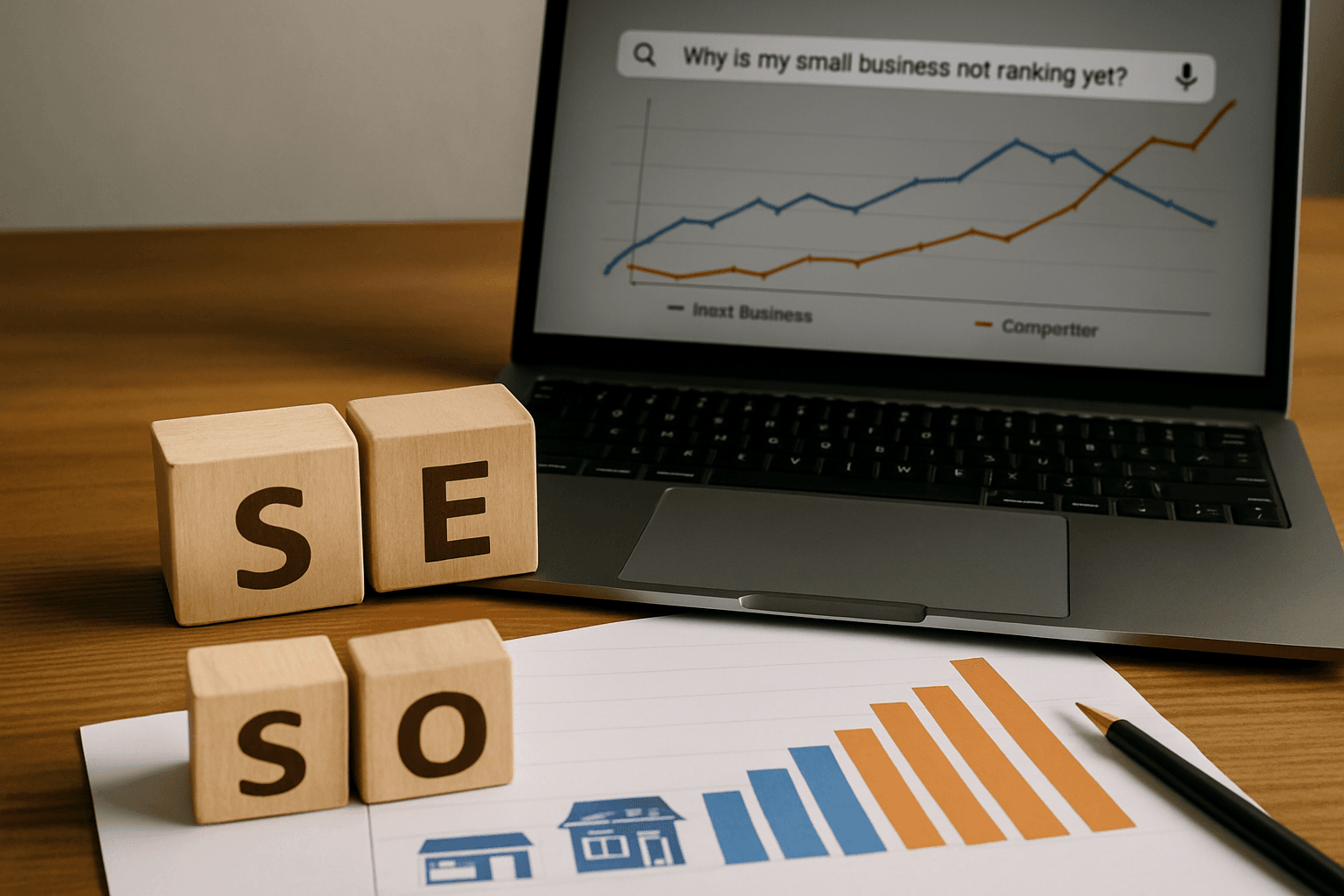
Why Your Small Business Isn't Ranking Yet: The 7 Hidden Variables
Understanding the timeline is one thing; understanding why your specific business might be ahead or behind that timeline is another. The frustrating reality is that "how long does small business SEO take" doesn't have a single answer because seven major variables interact in complex ways to either accelerate or stall your progress. Let's examine each one with the kind of specificity that actually helps you diagnose where you stand.
Your Starting Line: New Website vs. Established Domain
The age and history of your website matters more than most business owners realize. If you launched your site within the last six months, you're essentially starting from zero in Google's eyes, no trust, no authority, no track record of providing valuable content. Search engines have learned through painful experience that most new websites are either spam, abandoned projects, or businesses that will fail within their first year. They're not going to invest significant visibility in you until you prove you're here to stay.
In practice, this means a brand-new domain might need eight to twelve months to achieve what an established site accomplishes in four to six months, even with identical SEO strategies. The established site has already passed the credibility test; it just needs optimization. The new site needs optimization plus time to build that foundational trust. If your domain has been around for several years but you've neglected SEO until now, you're in a middle position, you have some accumulated authority from simply existing and (hopefully) earning a few natural backlinks over time, but you're starting from a low baseline of optimization. This is actually an ideal scenario in some ways, because you can see relatively quick improvements from fixing obvious problems while benefiting from your existing domain age.
There's also the question of your domain's history. If you purchased an expired domain or took over a website from a previous owner, you've inherited whatever reputation that domain had, for better or worse. A domain with a clean history and some quality backlinks is valuable. A domain that was previously penalized for spam or associated with sketchy content is a liability that might take months of rehabilitation before you see any positive movement. Always check a domain's history using tools like the Wayback Machine before committing to it for your business.
The Competition Factor: David vs. Goliath Industries
Not all industries are created equal when it comes to SEO difficulty. If you're a local plumber in a mid-sized city, you're competing against perhaps a dozen other plumbers who are actively investing in SEO, plus another few dozen who have accidentally decent websites from years of existence. That's manageable. If you're a personal injury attorney in Los Angeles, you're competing against law firms with seven-figure annual SEO budgets, teams of content writers, and relationships with every major publication in the region. The difference in timeline between these scenarios is enormous.
Competition affects not just how long it takes to rank, but what "ranking" even means for your business. In low-competition markets, getting to position three or four for your main keywords might generate substantial business because users don't have many alternatives. In highly competitive markets, anything outside the top three positions gets almost no clicks because users have learned that the top results in those industries are comprehensively better. You need to be realistic about what's achievable in your specific competitive landscape within your budget and timeline constraints.
Another dimension of competition that's often overlooked is the sophistication of your competitors' small business SEO. Are they publishing one blog post per month with basic keyword optimization, or are they executing comprehensive content strategies with cluster models, technical excellence, and aggressive link building? The gap between amateur SEO and professional SEO is wider than the gap between no SEO and amateur SEO. If your competitors are doing SEO poorly, you can leapfrog them relatively quickly with competent execution. If they're doing it well, you're in for a longer, more expensive battle that requires either outspending them, out-strategizing them, or finding underserved keyword opportunities they've missed.
The Content Quality Multiplier: Why Quantity Alone Fails
There's a persistent myth in small business SEO that you just need to publish more content, more blog posts, more service pages, more of everything, and rankings will follow. This was somewhat true a decade ago when the web was less saturated and Google's algorithms were less sophisticated. Today, publishing mediocre content at high volume is not only ineffective, it can actually harm your SEO by diluting your site's overall quality signals and making it harder for search engines to understand what you're actually about.
Quality in SEO content means several specific things that go beyond just "well-written." It means comprehensiveness, actually answering the user's question fully rather than dancing around it with filler paragraphs designed to hit a word count. It means originality, providing insights, data, or perspectives that users can't find elsewhere, rather than regurgitating the same information that's on twenty other sites. It means usefulness, giving readers something they can actually apply, whether that's actionable advice, decision-making frameworks, or just a clear explanation of a confusing topic. And increasingly, it means demonstrating real experience and expertise rather than generic knowledge anyone could compile from a quick Google search.
The quality multiplier works both ways. High-quality content doesn't just rank better; it attracts natural backlinks, gets shared on social media, keeps visitors on your site longer (which sends positive engagement signals to Google), and converts visitors into customers at higher rates. This creates a virtuous cycle where good content generates the exact signals that make Google want to rank it even higher. Conversely, low-quality content creates a vicious cycle: poor engagement metrics signal to Google that users don't find your content valuable, which leads to lower rankings, which leads to even less traffic and engagement. Many small businesses wonder why their competitors rank higher despite having "less content," and the answer is usually that the competitor's smaller volume of content is substantially higher quality.
Technical SEO Foundation: The Invisible Speed Bumps
While everyone focuses on content and links, technical SEO problems silently sabotage countless small business websites. These are the issues that prevent search engines from properly crawling, indexing, and understanding your site, things like slow page load speeds, broken internal links, duplicate content, missing or poorly implemented structured data, mobile usability problems, and convoluted site architecture that buries important pages five clicks deep from the homepage.
The insidious thing about technical SEO issues is that they're often invisible to business owners. Your site looks fine in your browser, customers can navigate it (mostly), and you're publishing content regularly, so everything seems okay. Meanwhile, Google's crawlers are encountering errors, getting confused by contradictory signals, or simply giving up before they've indexed your most important pages. You could have the best content in your industry and still rank poorly if the technical foundation is compromised.
What makes this particularly frustrating for small businesses is that technical SEO requires either specialized expertise or expensive tools to diagnose and fix properly. It's not something you can wing with common sense or a few YouTube tutorials. Issues like improper canonical tag implementation, inefficient JavaScript rendering, or suboptimal server response times require genuine technical knowledge to address. This is one area where the difference between DIY small business SEO and professional SEO becomes starkly apparent, professionals catch and fix these problems in the first month, while DIY efforts might struggle with them for years without even realizing they exist.
Your Resource Reality: Time, Money, and Expertise Trade-offs
Every small business faces the same fundamental constraint: you can't have everything. You can't have enterprise-level small business SEO results with a $500 monthly budget. You can't have fast results if you're only willing to spend two hours per week on SEO. You can't have sophisticated strategy if you're trying to do everything yourself with no training. Understanding your resource reality and making intelligent trade-offs within those constraints is often the difference between SEO that eventually succeeds and SEO that wastes money indefinitely.
The time-money-expertise triangle works like this: if you have limited money but abundant time, you can learn small business SEO yourself and execute it slowly but effectively, though you'll make expensive mistakes along the way and progress will be slower than with professional help. If you have money but limited time, hiring an agency or consultant makes sense because they compress months of learning and trial-and-error into efficient execution. If you have neither time nor money but do have some expertise, you can focus on the highest-leverage activities and accept that progress will be incremental. What doesn't work is having none of the three and expecting results anyway.
Many small businesses underestimate the ongoing resource commitment SEO requires. They budget for an initial website optimization but not for the continuous content creation, link building, technical maintenance, and strategic adjustment that sustained SEO success demands. It's like budgeting to build a garden but not to water it, you'll see some initial growth, but everything eventually withers. The most successful small business SEO efforts treat it as an ongoing operational expense, like rent or utilities, not a one-time project expense like a logo redesign. This mindset shift alone prevents the start-stop patterns that doom so many SEO initiatives.
The Smart Play: How to Actually Speed Up Results (Without Shortcuts)
Now that you understand the realistic SEO timeline and the variables that influence it, let's talk about what you can actually do to accelerate small business SEO results without resorting to the black-hat shortcuts that will eventually get you penalized. The key insight is that "speeding up" SEO doesn't mean finding loopholes or gaming the system, it means executing the fundamentals with exceptional thoroughness and strategic focus, eliminating wasted effort on activities that don't move the needle.
The first smart play is ruthless prioritization based on your specific situation. Rather than trying to do everything at once, local SEO, content marketing, link building, technical optimization, social media integration, identify the two or three highest-impact activities for your business and execute those brilliantly before expanding to other tactics. For most local service businesses, that means perfecting your Google Business Profile optimization and getting your technical foundation solid before worrying about content marketing. For e-commerce businesses, it often means product page optimization and site speed before blog content. For professional services targeting small business SEO, it might be thought leadership content and strategic link building. The specific priorities vary, but the principle is universal: depth in the right areas beats shallow coverage of everything.
Another acceleration strategy is leveraging automation intelligently. Notice the qualifier: intelligently. Automation in SEO has a terrible reputation because it's been abused by spammers for decades, automated content generation, automated link building, automated social signals, all of which produce garbage that harms rather than helps. But modern AI-driven tools have reached a point where they can genuinely accelerate the mechanical, time-consuming parts of SEO without sacrificing quality, freeing up human expertise for the strategic decisions that actually require judgment and creativity.
This is where platforms like SEO Siah become relevant for small businesses facing the resource constraints we discussed earlier. The traditional choice has been binary: either spend $2,000+ per month on an agency, or spend dozens of hours per week doing everything yourself with mediocre results. Automation platforms create a third option by handling the systematic, repeatable parts of small business SEO, keyword research, content structure planning, technical optimization checklists, publishing workflows, while keeping humans in the loop for strategy, quality control, and the creative elements that differentiate your content from competitors. For business owners who want SEO handled without becoming SEO experts themselves, this approach provides end-to-end execution without requiring constant involvement. For SEO specialists managing multiple clients, it becomes a force multiplier that lets them maintain quality while handling more accounts than would be possible with purely manual processes.
The critical distinction is between automation that replaces human judgment (usually bad) and automation that augments human capability (potentially very good). Automated keyword research that identifies opportunities you would have missed manually? Valuable. Automated content generation that publishes without human review? Disaster waiting to happen. Automated technical audits that surface issues you'd spend hours finding manually? Time-saver. Automated link building through blog comment spam? Penalty risk. The smart play is using automation for the diagnostic, organizational, and execution support tasks while keeping human expertise focused on strategy, quality, and the nuanced decisions that require understanding your specific business context.
Should you hire an agency, use software, or do it yourself? The honest answer depends entirely on your specific situation. If you're a solo entrepreneur with more time than money and genuine interest in learning SEO, the DIY route can work, though expect a steep learning curve and slower results while you figure things out. If you're running a business that's already generating significant revenue and your time is better spent on operations, sales, or product development, paying professionals, whether an agency or using sophisticated automation tools, makes economic sense. The middle ground of "I'll have my nephew who's good with computers handle it" or "I'll just pay someone on Fiverr" is where most small business SEO efforts go to die. Cheap SEO is almost always more expensive in the long run because you waste months or years with no results, then have to pay again to fix the damage and do it properly.
What you absolutely should not do is chase shortcuts. Every few months, some new "SEO hack" makes the rounds on social media, a loophole in Google's algorithm, a way to rank overnight, a secret technique the pros don't want you to know about. These are either outdated tactics that stopped working years ago, techniques that will get you penalized when Google inevitably catches on, or outright scams. The boring truth is that SEO that works long-term is built on fundamentals: making your site technically excellent, creating genuinely useful content, building real relationships that lead to quality backlinks, and optimizing based on data rather than assumptions. This approach doesn't make for exciting marketing copy, but it's what actually works in 2024 and will likely continue working for years to come.
The final smart play is setting up proper measurement and being willing to adjust based on what the data tells you. Too many small businesses either don't track their SEO results tracking at all, or they track vanity metrics like "total website traffic" without understanding whether that traffic is actually valuable. Set up goals in Google Analytics that track actual business outcomes, form submissions, phone calls, purchases, whatever constitutes a conversion for your business. Monitor which keywords are driving those conversions, not just which keywords are driving traffic. Review your rankings monthly, but don't panic over day-to-day fluctuations that are normal algorithm noise. And be willing to kill tactics that aren't working and double down on the ones that are, even if that means abandoning your original plan. Flexibility based on evidence, not stubbornness based on sunk costs, is what separates small business SEO that eventually succeeds from efforts that waste money indefinitely.
The timeline for small business SEO results is longer than you want, but shorter than you fear if you approach it strategically. Four to six months for noticeable improvements, six to twelve months for substantial growth, and ongoing optimization to maintain and expand those results. It's not a quick fix, but it's one of the few marketing channels that gets more effective and less expensive over time rather than the reverse. The businesses that succeed with SEO are the ones that commit to the timeline, understand their specific variables, and execute consistently with quality rather than looking for shortcuts. That's the brutal truth, but it's also the path that actually works.
| Timeline | Stage | What You'll See | Real-World Example |
|---|---|---|---|
| 1–3 months | Quick Wins | Technical improvements, faster site speeds, small ranking gains for low-competition keywords | Established sites see minor traffic increases from on-page optimizations |
| 4–6 months | Noticeable Growth | Steady ranking improvements, increased organic traffic, early lead generation | Snow bike company: 77,562 new clicks, 78 first-page rankings, $96,664 in revenue |
| 6–8 months | Accelerating Results | Significant traffic increases, multiple first-page rankings, consistent lead flow | Dental practice: 340% increase in local organic traffic |
| 12+ months | Substantial ROI | Doubled leads/sales, compounding visibility gains, strong market position | E-commerce business: 427% increase in non-branded traffic over 2 years |
The Timeline Is Long, But the Payoff Is Real
Here's what we've established through data, research, and real-world observation: small business SEO is a 6-to-12-month commitment before you'll see meaningful organic traffic, and another 6 months beyond that before it becomes a reliable revenue driver. That's not pessimism, it's the honest timeline backed by industry studies, search engine behavior, and the experiences of thousands of small businesses who've walked this path before you. The brutal truth isn't that SEO doesn't work; it's that it works slowly, and most businesses quit right before the compounding effect kicks in.
But now you understand why the timeline exists. You know that Google needs time to crawl, index, evaluate, and trust your content. You've seen how domain authority builds incrementally, how backlinks accumulate gradually, and how competitive keywords require sustained effort. More importantly, you've learned how to set realistic milestones, measure progress beyond rankings, and avoid the expensive mistakes that derail most small business SEO efforts in the first six months.
So what comes next? Start with the fundamentals: technical health, keyword research aligned with actual search intent, and a content calendar you can sustain without burning out. If you're looking for a system that handles the heavy lifting, research, strategy, content creation, and publishing, while you focus on running your business, that's exactly what SEO Siah was built to do. It's not magic, and it won't compress that 6-month timeline into 6 weeks, but it will eliminate the guesswork and manual grunt work that makes SEO feel impossible for small teams.
The businesses that win at SEO aren't the ones with the biggest budgets or the flashiest tactics. They're the ones who show up consistently, measure what matters, and stay in the game long enough for compound growth to take over.
Frequently Asked Questions
How long does SEO take for small business?
Most small businesses see initial measurable SEO results within 4-6 months of consistent work. Substantial growth that significantly impacts revenue typically takes 6-12 months. Brand new websites may need 8-12 months due to Google's trust-building period, while established domains with some existing authority can see improvements in the 4-6 month range. The timeline varies based on competition level, starting point, content quality, and resource investment.
What affects how long SEO takes?
Seven major factors influence your SEO timeline: website age and domain authority, industry competition level, content quality and publishing frequency, technical SEO foundation, existing backlink profile, local versus national focus, and available resources (time, money, expertise). New websites in highly competitive industries with limited budgets will take longer than established sites in niche markets with professional execution.
When will I see results from SEO?
You'll see different types of results at different stages. In months 1-3, expect technical improvements and minor ranking gains for low-competition keywords. Months 4-6 bring noticeable traffic increases and early lead generation. Months 6-12 deliver significant ranking improvements and consistent business impact. Results compound over time, so the longer you maintain quality SEO efforts, the better your returns become.
How do I know if SEO is working?
Track these early indicators before rankings improve: increased pages indexed by Google, growing search impressions in Google Search Console, improving average position for target keywords, longer time-on-site and lower bounce rates, and increasing branded search volume. Set up conversion tracking in Google Analytics to measure actual business outcomes like form submissions, phone calls, or purchases, not just traffic volume.
Can I speed up my SEO results?
You can accelerate results through strategic prioritization, not shortcuts. Focus on high-impact activities for your specific business type, fix technical issues immediately, target low-competition "quick win" keywords first, publish high-quality content consistently, and leverage intelligent automation for repetitive tasks. Avoid black-hat tactics like buying links or keyword stuffing, these create penalties that set you back months.
Should I hire an SEO agency or use software?
The right choice depends on your resources and expertise. DIY small business SEO works if you have time to learn and execute consistently, but expect slower results during your learning curve. Agencies provide expertise and faster execution but cost $2,000+ monthly. Modern automation platforms offer a middle ground, handling systematic tasks while keeping you in control of strategy and quality. Choose based on your available time, budget, and willingness to learn SEO fundamentals.
Why is my small business not ranking yet?
Common reasons include: insufficient time invested (less than 4-6 months), technical SEO problems blocking search engines, low-quality or thin content, targeting overly competitive keywords, lack of quality backlinks, inconsistent execution, or penalties from previous black-hat tactics. Run a technical audit, review your content quality honestly, check your backlink profile, and ensure you're targeting realistic keywords for your authority level.
How often should I publish content for SEO results?
Quality matters more than frequency. One comprehensive, well-researched article per week outperforms five mediocre posts. For most small businesses, 2-4 high-quality pieces per month is sustainable and effective. Focus on thoroughly answering user questions, demonstrating real expertise, and providing unique value. Consistency matters, publishing regularly over 6-12 months beats sporadic bursts of activity followed by months of silence.