Local Business SEO Setup: Honest Timeline & Results
How Long Does SEO Take to Setup for a Local Business? (The Honest Timeline)

You've just invested thousands of dollars in a beautiful new website for your local business, optimized your Google Business Profile, and now you're staring at your analytics dashboard wondering: "When will this actually work?" If you're like most local business owners I've encountered, you're caught between the agency promising "results in 90 days" and the DIY guide claiming you'll rank "within weeks." The truth about local business SEO timelines is far more nuanced, and honestly, more interesting, than either extreme suggests.
Here's what most SEO advice won't tell you upfront: the timeline for local business SEO depends less on some universal countdown clock and more on where you're starting, who you're competing against, and how strategically you approach the setup phase. I've seen cleaning companies achieve 480% traffic increases in eight months, while other businesses in saturated markets take twice as long to break through. The difference? Understanding that SEO isn't just about "doing the work", it's about doing the right work in a sequence that compounds results over time.
This article cuts through the optimistic promises and pessimistic warnings to give you an honest, research-backed timeline for local business SEO setup. We'll explore the realistic milestones you should expect at 4 weeks, 3 months, 6 months, and beyond, plus the critical factors that accelerate or delay your progress. Whether you're considering how long does SEO take for local business success or debating should I hire agency or automate SEO setup, you'll walk away with a clear roadmap and the knowledge to make informed decisions about your investment.
The Reality Check: Why Most Local Business Owners Get SEO Timelines Wrong
When you first start exploring local business SEO, you'll probably encounter two wildly different narratives. The first comes from agencies promising page-one rankings within weeks, complete with glossy case studies and impressive charts. The second emerges from business owners in forums, sharing war stories about investing months or even years without seeing meaningful results. Both perspectives exist, yet neither tells the complete story about what you should actually expect when setting up SEO for your local business.
The fundamental disconnect happens because most people confuse two entirely different concepts: the time required to set up SEO versus the time needed to see results from that setup. The seo setup time for your technical infrastructure, optimizing your Google Business Profile, and getting your foundational elements in place might take anywhere from a few weeks to a couple of months depending on your starting point. But here's what catches people off guard, that setup phase represents just the beginning of your SEO journey, not the finish line. The real timeline extends far beyond those initial weeks because search engines need time to crawl your site, evaluate your content, compare you against competitors, and gradually build confidence in your local authority.
Think about it from Google's perspective for a moment. When you launch a new website or suddenly optimize an existing one, Google doesn't immediately trust that you're the best answer for local searches in your area. Why would it? Dozens or even hundreds of other businesses in your market have been building their online presence for years, accumulating reviews, earning backlinks, and demonstrating consistent value to customers. Google's primary obligation is to its users, the people typing searches into that box, and serving them unproven businesses would undermine the search experience. This inherent skepticism means that even perfectly executed SEO setups require a proving period, typically spanning several months, before you'll see substantial ranking improvements.
Another reason expectations get skewed involves the competitive landscape in your specific market. A local bakery in a small town with minimal competition might see meaningful traction within the first 4 to 6 weeks of consistent effort, landing solid first-page rankings for key local terms relatively quickly. Meanwhile, a personal injury attorney in a major metropolitan area faces an entirely different battle, competing against established firms with massive marketing budgets, years of accumulated domain authority, and comprehensive content libraries. The local business SEO process might be identical for both businesses, but the timeline to achieve comparable results differs dramatically based on competitive intensity.
The truth about local seo timeline expectations sits somewhere in the middle of those extreme narratives. You won't see overnight miracles, but you also shouldn't resign yourself to years of invisible effort. Most local businesses operating in moderately competitive markets can expect to see early indicators within the first month or two, perhaps your Google Business Profile starts appearing in more searches, or you notice a slight uptick in organic traffic. However, the substantial business impact that actually moves the needle, consistent leads, increased foot traffic, meaningful revenue growth, typically materializes between the six and twelve-month mark after implementing a solid SEO strategy. Understanding this realistic timeline from the outset helps you avoid the disappointment of premature expectations while staying motivated through the necessary building phase.
Breaking Down the Local Business SEO Setup: What Actually Takes Time (And What Doesn't)
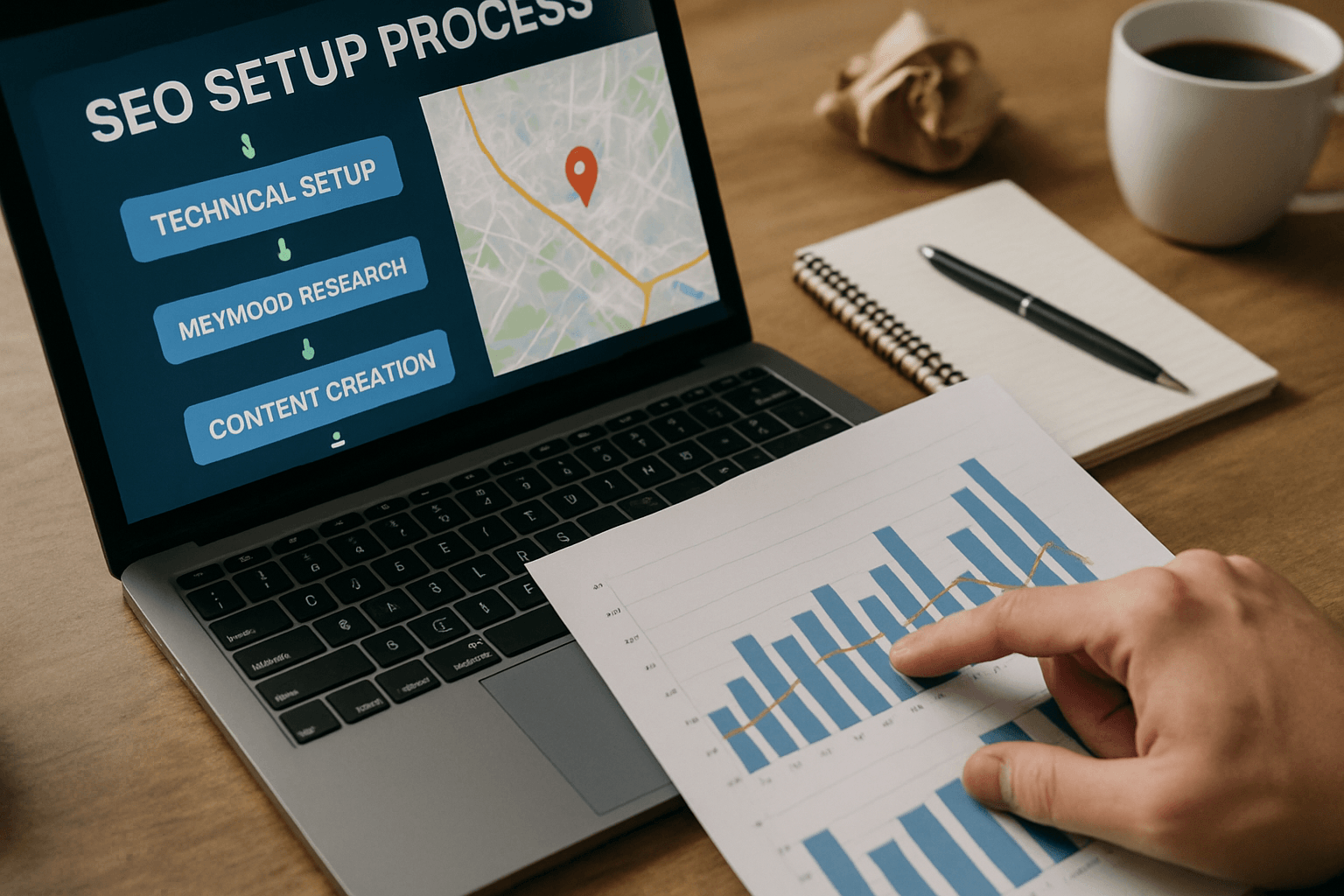
Now that we've established realistic expectations, let's examine what actually happens during the seo setup process and where your time gets invested. The journey breaks down into distinct phases, each with its own timeline and priorities, building progressively toward a comprehensive local SEO foundation.
The Foundation Phase: Technical Setup and Google Business Profile (Week 1-2)
Your first two weeks focus on establishing the technical infrastructure that everything else builds upon. This phase moves relatively quickly because it involves concrete, actionable tasks with clear completion criteria. You'll start by claiming and optimizing your Google Business Profile, which serves as the cornerstone of local SEO. This means filling out every available field with accurate information, your business name, address, phone number, website URL, hours of operation, service areas, and business categories. Each detail matters because Google uses this information to determine when and where to display your business in local search results.
Beyond the basic information, you'll upload high-quality photos of your business, products, or services, write a compelling business description that naturally incorporates relevant keywords, and begin the process of gathering initial reviews from satisfied customers. Many business owners rush through this step, treating it like a simple directory listing, but your Google Business Profile often serves as the first impression potential customers get of your business. Investing time to make it comprehensive and appealing pays dividends throughout your SEO journey. The technical setup also includes ensuring your website loads quickly, works properly on mobile devices, and has basic on-page elements like title tags, meta descriptions, and header tags in place. If you're starting with a well-designed modern website, these elements might already be optimized. If you're working with an older site, this phase might extend slightly as you address technical debt.
The beauty of this foundation phase is its relative predictability. Unlike the content creation or link building that comes later, technical setup follows a checklist approach. You either have schema markup implemented or you don't. Your site either loads in under three seconds or it needs optimization. Your NAP (Name, Address, Phone) information either matches across all platforms or it requires correction. This concrete nature means you can move through the foundation phase efficiently, typically completing it within two weeks even if you're handling everything yourself.
The Research Phase: Keywords, Competitors, and Local Market Analysis (Week 2-3)
Overlapping with the tail end of your foundation work, the research phase involves understanding your competitive landscape and identifying the specific terms your potential customers actually use when searching for businesses like yours. This phase proves deceptively complex because effective keyword research for local businesses differs significantly from broader SEO strategies. You're not just looking for high-volume keywords, you need terms with local intent that indicate someone is ready to visit a business or make a purchase in your area.
Start by brainstorming the services you offer and how customers might describe them. A plumber might initially think "plumbing services" covers everything, but actual search behavior reveals far more specific queries: "emergency pipe repair," "water heater installation," "bathroom remodel plumber," or "sewer line replacement." Each of these represents a different customer need and potentially a different page or piece of content on your website. Tools like Google's Keyword Planner, Ahrefs, or SEMrush help you identify search volumes and competition levels for these terms, but don't overlook the free insights available directly in Google Search Console and your Google Business Profile insights, which show you exactly what queries are already bringing people to your business.
The competitive analysis component of this phase involves examining what other local businesses in your space are doing successfully. Which keywords are they ranking for? What content have they created? How robust are their review profiles? What local citations and backlinks have they accumulated? This reconnaissance isn't about copying competitors but rather understanding the baseline you need to meet and the opportunities they've overlooked. You might discover that while three competitors dominate general plumbing terms, nobody has really optimized for "eco-friendly plumbing solutions" or "smart home plumbing installations", potential niches where you could establish authority more quickly.
This research phase typically requires one to two weeks of focused effort, though it's something you'll revisit periodically as your business evolves and new opportunities emerge. The investment here dramatically impacts everything that follows because your keyword research informs your content strategy, your on-page optimization, and even your link building priorities. Rushing through research to jump into execution often means creating content that doesn't match actual search behavior, optimizing for terms nobody searches for, or missing entirely the opportunities where you could gain traction most quickly.
The Content Phase: Creating and Optimizing Your Local Presence (Week 3-6)
Armed with your research insights, you enter the content phase where you create and optimize the assets that will actually attract local customers. This phase consumes the most time during setup because quality content creation simply cannot be rushed. You'll need to develop or refine your website's core pages, your homepage, service pages, about page, and contact page, ensuring each one incorporates relevant local keywords naturally while providing genuine value to visitors. The goal isn't keyword stuffing or writing for search engines; it's creating content that answers the questions your potential customers are asking while signaling to Google that you're relevant for specific local searches.
For local businesses, location-specific content proves particularly valuable. If you serve multiple neighborhoods or cities, creating dedicated pages for each location helps you capture searches with geographic modifiers. A roofing company might develop separate pages for "roof repair in [Neighborhood A]" and "roof installation in [Neighborhood B]," each featuring unique content about the specific challenges and considerations in that area. This approach works because it matches how people actually search, they're not looking for a roofer in general, they're looking for a roofer near them, in their specific community. The content phase also includes creating blog posts or resources that address common customer questions, establish your expertise, and provide opportunities to naturally incorporate the long-tail keywords you identified during research.
Beyond your website, this phase involves optimizing your presence on other platforms where potential customers might discover you. That means creating or updating profiles on relevant directories and citation sites, Yelp, Yellow Pages, industry-specific directories, local chamber of commerce listings, and dozens of others depending on your business type. Consistency matters enormously here; your business name, address, and phone number must match exactly across every platform. Even minor variations like "Street" versus "St." or including a suite number on some listings but not others can confuse search engines and dilute your local SEO effectiveness. Many businesses underestimate how many citations exist for their business, making this audit and cleanup process time-consuming but essential.
The content phase typically spans three to four weeks of active work, though it can extend longer for businesses with complex service offerings or those operating in multiple locations. The key is prioritizing quality over speed. One comprehensive, genuinely helpful service page that thoroughly addresses customer needs and questions will outperform five thin, keyword-stuffed pages every time. Similarly, ten accurate, complete citations on high-authority directories prove more valuable than fifty rushed listings with inconsistent information. As you move through this phase, you're not just checking boxes, you're building the substance that will support your rankings for months and years to come.
The Authority Phase: Citations, Reviews, and Link Building (Ongoing)
Once your foundation, research, and content are in place, you enter what I call the authority phase, and here's where the timeline shifts from "setup" to "ongoing strategy." This phase never truly ends because building local authority requires consistent, sustained effort over time. Unlike the previous phases with their concrete completion criteria, authority building is about momentum and accumulation. Each citation you earn, each review you receive, and each link you acquire adds incrementally to your local prominence, but the impact compounds over months rather than appearing immediately.
Review generation becomes a critical focus during this phase. According to industry research, Google considers prominence, essentially your online reputation and authority, as one of three primary factors in local search rankings. Reviews serve as the most visible indicator of that prominence. You need a systematic approach to encourage satisfied customers to leave reviews on your Google Business Profile, and ideally on other relevant platforms like Yelp, Facebook, or industry-specific review sites. This isn't a one-time task; it's an ongoing process that should become part of your standard customer follow-up workflow. Businesses that consistently generate fresh reviews signal to Google that they're actively serving customers and maintaining quality, which positively impacts rankings over time.
Link building for local businesses differs from traditional SEO link building because you're focused on locally relevant, authoritative sources rather than just any high-domain-authority website. Sponsoring a local charity event, joining your chamber of commerce, getting featured in local news coverage, partnering with complementary local businesses, or contributing expert quotes to local publications, all of these activities can generate valuable local backlinks. These links matter not just because of their SEO value but because they demonstrate your genuine connection to and involvement in your local community. Google increasingly prioritizes these relevance signals when determining which businesses deserve visibility in local search results.
The authority phase extends well beyond your initial setup period, continuing for as long as you want to maintain and improve your local search visibility. However, the most intensive work typically happens in the first three to six months after completing your content phase, as you actively pursue citation opportunities, implement review generation systems, and reach out for initial link building opportunities. After that, authority building becomes more about consistency, maintaining a steady flow of new reviews, periodically pursuing new citations as directories emerge, and opportunistically earning links through your ongoing business activities and community involvement. This ongoing nature is precisely why substantial and consistent results typically require 6 to 12 months of solid SEO effort, with the most significant traffic and ranking improvements materializing after you've built sufficient authority signals over time.
The Game-Changer: How Automation and AI Are Rewriting SEO Setup Timelines
While the traditional local seo timeline I've described remains accurate for manual implementation, we're witnessing a fundamental shift in what's possible thanks to automation and artificial intelligence. These technologies aren't just making existing processes slightly faster, they're fundamentally restructuring which tasks consume time and which can be handled in minutes rather than weeks. For local business owners and SEO specialists alike, understanding how to leverage these tools strategically can compress setup timelines dramatically while potentially improving quality and consistency.
The most immediate impact of ai seo tools appears in the research and content phases that traditionally consumed the bulk of setup time. What once required hours of manual keyword research, competitor analysis, and content planning can now be automated through intelligent systems that analyze search patterns, competitive landscapes, and content opportunities at scale. Platforms like SEO Siah exemplify this shift by automating the entire content ecosystem, from keyword research and strategic planning to content generation and publishing. For business owners without deep SEO knowledge, this means accessing sophisticated strategies that would typically require hiring an agency. For SEO specialists and agencies, it means dramatically increasing capacity and handling more clients without proportionally increasing team size.
The automation advantage extends beyond just speed. AI-powered seo setup systems can maintain consistency across hundreds of content pieces and citations in ways that manual processes struggle to match. Remember that critical NAP consistency we discussed, ensuring your business name, address, and phone number match exactly across every online platform? Manual checking is tedious and error-prone, but automated systems can audit hundreds of citations, identify discrepancies, and even submit corrections in a fraction of the time. Similarly, content generation tools can maintain consistent keyword integration, proper heading structure, and comprehensive coverage across your entire website, avoiding the quality variations that naturally occur when humans write dozens of pages over several weeks.
Perhaps most significantly, automated seo setup enables local businesses to implement sophisticated strategies that would otherwise remain out of reach due to resource constraints. Consider the pillar-cluster content model, where you create comprehensive pillar pages on broad topics supported by detailed cluster content on specific subtopics, all internally linked in strategic ways. This approach works brilliantly for SEO but requires planning and executing perhaps twenty or thirty interconnected pieces of content. For a small business owner handling marketing alongside running their business, that's often simply too much to manage. But with automated content generation, you can implement these advanced strategies without the proportional time investment, potentially achieving results that would typically require a full marketing team.
The hybrid approach, combining AI automation with human expertise and oversight, often delivers the best outcomes, especially for local businesses where authentic community connection matters. You might use automation to generate initial content drafts, conduct comprehensive keyword research, and identify citation opportunities, then apply human judgment to refine the content with specific local knowledge, add personality that reflects your brand voice, and prioritize which opportunities to pursue based on your market understanding. This combination compresses timelines while maintaining the authentic, locally relevant quality that both customers and search engines value. For SEO specialists and agencies, tools like SEO Siah function as production engines that handle the scalable, repeatable aspects of SEO while freeing up expert time for strategy, client relationships, and the nuanced decisions that still require human insight.
Making Your Decision: Manual, Automated, or Hybrid Approach for Your Local Business
Standing at the beginning of your local SEO journey, you face a fundamental decision about how to approach the setup process. Should I hire agency or automate SEO setup? Should you handle everything manually, invest in automation tools, hire an agency, or combine these approaches in some hybrid model? The right answer depends on your specific situation, your budget, timeline, technical comfort level, and long-term business goals, but understanding the trade-offs helps you make an informed choice rather than defaulting to whatever option you encounter first.
The manual approach offers maximum control and the lowest upfront financial investment, requiring only your time and effort. If you're willing to invest several hours weekly over the course of three to six months, you can absolutely handle your local business SEO setup yourself using free resources and tools. This path makes particular sense if you're operating in a low-competition market, have a relatively simple service offering, and enjoy learning new skills. The learning curve proves steeper than many expect, but the knowledge you gain becomes a permanent asset for your business. You'll understand exactly what's working and why, making you less dependent on external help for ongoing optimization. However, the time investment is substantial, easily 10-15 hours weekly during the intensive setup phase, and the opportunity cost matters. Those hours spent learning keyword research and optimizing meta descriptions are hours not spent serving customers, refining your service delivery, or pursuing business development opportunities.
Hiring an agency represents the opposite trade-off: higher financial investment but minimal time commitment from you. Quality agencies specializing in local business SEO typically charge anywhere from $1,000 to $5,000 monthly depending on your market competitiveness and the scope of services included. For that investment, you get expert implementation, proven processes, and the benefit of experience across multiple clients and industries. Agencies can often achieve results faster than solo efforts because they're not learning as they go, they already know which strategies work in your market and which tactics to avoid. The challenge with agencies lies in finding one that's genuinely competent, transparent about their methods, and aligned with your business goals. The local SEO space unfortunately includes plenty of providers offering outdated tactics, making unrealistic promises, or delivering minimal actual value while locking clients into long-term contracts. Thorough vetting becomes essential, and even then, you're placing significant trust in an external partner's expertise and integrity.
The automated seo setup approach using AI-powered tools like SEO Siah offers a middle path that's increasingly compelling for many local businesses. These platforms typically cost significantly less than agency services, often a few hundred dollars monthly rather than thousands, while dramatically reducing the time investment compared to manual implementation. You get sophisticated strategies and comprehensive execution without needing to become an SEO expert yourself or surrender complete control to an external agency. The automation handles the scalable, repeatable aspects, keyword research, content generation, technical optimization, citation management, while you maintain oversight and inject the local knowledge and authentic voice that automation can't fully replicate. This approach proves particularly valuable if you're operating multiple locations, want to implement advanced strategies without the corresponding time investment, or need to scale your SEO efforts as your business grows.
For many local businesses, the optimal solution combines elements of all three approaches in what I'd call a strategic hybrid model. You might use automation tools to handle the heavy lifting of content creation and technical optimization, reducing what would be months of manual work to weeks or even days. Then you apply your own local expertise to refine that automated output, ensuring it reflects your specific market knowledge and community understanding. Perhaps you engage an agency or consultant on a limited basis, not for full ongoing management but for strategic guidance, periodic audits, and help navigating complex technical challenges. This hybrid approach lets you move quickly through the setup phase while maintaining quality and authenticity, typically achieving meaningful results within that critical six-to-twelve-month window where businesses either see traction and commit to SEO long-term or become discouraged and abandon the effort.
The decision ultimately comes down to your honest assessment of three factors: the time you can realistically commit to SEO implementation, the budget you have available for tools or services, and how quickly you need to see results given your competitive situation. A new business in a competitive market might need the speed advantage of automation or agency help, while an established business with stable revenue can afford the longer timeline of manual implementation. A technically inclined owner might enjoy the learning process and control of the DIY approach, while an owner focused purely on business operations might prefer delegating entirely to experts or automation. There's no universally correct answer, but understanding these trade-offs helps you choose the path that aligns with your specific situation rather than simply accepting whatever approach you encounter first.
What matters most isn't which specific approach you choose but that you commit to consistent execution over that crucial six-to-twelve-month period. Real-world examples demonstrate the payoff of sustained effort, like the Texas cleaning services company that achieved a 480% increase in website traffic and 89% increase in conversions over eight months of focused local business SEO work. Those results didn't come from a single brilliant tactic or shortcut but from consistent, comprehensive optimization across multiple channels over time. Whether you're implementing that strategy manually, through automation, or via an agency partnership, the commitment to sustained effort matters more than the specific execution method. Choose the approach that you can actually maintain consistently for the next year, because in local SEO, consistency and persistence ultimately determine success far more than any individual tactical decision.
| Timeframe | Expected Results | Key Activities | Traffic Impact |
|---|---|---|---|
| First Few Weeks | Website appears in local searches; minimal ranking improvements | Google My Business optimization, NAP consistency, keyword research, basic on-page optimization | Minimal increase |
| 4-6 Weeks | Solid first-page rankings for some local keywords | Ongoing content optimization, local citations building | Early signs of growth |
| 3-6 Months | Noticeable traffic increases, improved local pack visibility | Consistent GMB updates, link-building, content expansion | Moderate increase (20-50%) |
| 6-12 Months | Significant traffic jumps, multiple page 1 rankings, improved conversions | Advanced optimization, reputation management, ongoing content strategy | Substantial increase (45-480% possible) |
| 8+ Months | Established authority, consistent lead generation, strong local presence | Maintenance and expansion of successful strategies | Sustained high performance |
The Real Timeline: What You Should Expect
Setting up local business SEO isn't a weekend project, and anyone who tells you otherwise is selling something. As we've walked through the honest timeline, from the initial 2-4 weeks of technical setup through the 3-6 month window where you'll start seeing meaningful traction, you now have a realistic framework for what lies ahead. The businesses that succeed with local SEO are the ones that understand it's not about flipping a switch, but rather building a foundation that compounds over time.
What matters most isn't how quickly you can check boxes on a setup checklist. It's whether you're approaching local business SEO with the consistency and strategic thinking it demands. The technical elements, your Google Business Profile optimization, citation building, on-page improvements, these create the scaffolding. But the ongoing content creation, review generation, and local link building? That's what actually moves the needle month after month. The seo setup time we've outlined isn't arbitrary; it reflects how search engines evaluate trust, relevance, and authority in local markets.
If you're feeling overwhelmed by the scope of what needs to happen, that's completely normal. The good news is that much of the heavy lifting can be systematized once you understand the sequence. Tools like SEO Siah can handle the content production side, automating keyword research, generating optimized articles, and maintaining publishing consistency, so you're not stuck choosing between running your business and feeding your SEO strategy. The platform's built specifically to remove the manual bottlenecks that make local SEO feel impossible for busy business owners.
Here's what you should do next: audit where you currently stand. If you haven't claimed your Google Business Profile or your website lacks basic local optimization, start there. If those foundations are solid, shift your focus to the content calendar and review acquisition process that will carry you through months 3-6 and beyond. The timeline is long, but every week you delay is another week your competitors are building their advantage. Start with what you can control today, stay consistent, and trust the process to deliver results when the time is right.
Related Articles
- How Long Does SEO Take to Setup for a Local Business?
- Should I Hire Agency or Automate SEO Setup?
- Local SEO Strategy Implementation Guide
Frequently Asked Questions
How long does keyword research take for local SEO?
Comprehensive keyword research for a local business typically takes 1-2 weeks when done manually. This includes identifying service-specific terms, analyzing local search intent, evaluating competitor keywords, and mapping keywords to your content strategy. With automated tools, this process can be compressed to just a few days while potentially uncovering more opportunities through AI-powered analysis of search patterns and competitive gaps.
What takes the most time in SEO setup?
Content creation and optimization consume the most time during local SEO setup, typically requiring 3-6 weeks of focused effort. This includes writing or rewriting service pages, creating location-specific content, developing blog posts, and ensuring all content properly incorporates keywords while providing genuine value. The second most time-intensive task is building and verifying local citations across dozens of directories, which requires meticulous attention to NAP consistency.
Is automated SEO setup faster than manual?
Yes, automated SEO setup is significantly faster than manual implementation. Tasks that might take weeks manually, like keyword research, content generation, and technical optimization, can be completed in days or even hours with AI-powered tools. However, the best results come from a hybrid approach where automation handles scalable tasks while human expertise adds local knowledge, brand voice, and strategic oversight that automation alone cannot replicate.
How long before local SEO shows results?
Most local businesses begin seeing early indicators within 4-6 weeks, perhaps improved Google Business Profile visibility or slight traffic increases. However, substantial results that meaningfully impact your business typically appear between 6-12 months after implementing a comprehensive SEO strategy. The timeline depends on your starting point, competitive intensity in your market, and the consistency of your optimization efforts.
Why isn't my local SEO working after 2 months?
Two months is typically too early to expect significant results from local SEO, especially in competitive markets. Search engines need time to crawl your site, evaluate your content, and build confidence in your authority. If you're seeing absolutely no movement after 2 months, check that your technical foundation is solid (proper indexing, no crawl errors), your Google Business Profile is fully optimized, and you're consistently generating fresh content and reviews. Patience combined with consistent execution is essential.
How long does WordPress SEO setup take?
WordPress SEO setup for a local business typically takes 2-4 weeks for the technical foundation, including installing and configuring SEO plugins (like Yoast or Rank Math), optimizing site speed, ensuring mobile responsiveness, implementing schema markup, and setting up proper permalink structures. The platform's plugin ecosystem can accelerate many technical tasks, but content creation and ongoing optimization still require the same time investment regardless of your CMS.