Estimated reading time: 22 minutes
Table of Contents
- The Uncomfortable Truth About SEO Timelines (And Why Most Advice Gets It Wrong)
- The 7 Variables That Control Your Timeline (And Which Ones You Can Actually Fix)
- How to Speed Up Results Without Spending Thousands on an Agency
- Your Next 30 Days: The SEO Starter Plan That Actually Moves the Needle
- Conclusion
- Frequently Asked Questions
You've probably Googled some version of "how long does SEO take for small business" at 2 AM, staring at your laptop, wondering if you should just throw money at ads instead. Here's the answer nobody wants to hear: SEO isn't a light switch. It's more like planting a garden, you'll see sprouts before the harvest, but you need to know what you're actually waiting for and why.
The frustrating truth is that most SEO advice either promises unrealistic overnight success or delivers vague platitudes about "patience and consistency." Meanwhile, you're trying to make payroll and justify marketing spend with actual numbers. Real small businesses, the bakery down the street, the plumber who finally claimed his Google listing, the B2B startup bootstrapping growth, are seeing measurable results in that critical 3-to-6-month window. But what does "results" actually mean? And what separates businesses that gain traction from those still waiting after a year?
This article breaks down the realistic SEO timeline for small business owners who need to make informed decisions, whether you're doing this yourself or evaluating if you even need outside help. We'll walk through what actually happens month-by-month (not the sanitized agency version), examine real case studies with specific numbers, and show you which efforts move the needle fastest when you're working with limited time and budget. You'll also learn the common mistakes that unknowingly add months to your timeline, technical issues, listing inconsistencies, and strategy gaps that most small businesses don't realize they have until it's too late.
By the end, you'll have a framework for setting realistic expectations and a clear action plan for the first 90 days.
The Uncomfortable Truth About SEO Timelines (And Why Most Advice Gets It Wrong)
You've probably heard conflicting advice about how long SEO takes for small businesses. Some gurus promise results in 30 days. Others warn you'll wait a year or more. The truth? Both are misleading, and understanding why requires looking at what actually happens behind the scenes when you optimize a small business website.
The realistic SEO timeline for small businesses falls between three to six months before you see measurable results, with full impact often taking up to a year. This isn't arbitrary, it reflects how search engines work, how competitive your market is, and what foundation you're starting from. When someone promises faster results, they're either selling you something or talking about paid advertising, not organic SEO.
Here's what makes SEO timelines so misunderstood: search engines don't reward effort immediately. They reward consistency, relevance, and trust built over time. When you publish optimized content or fix technical issues, Google doesn't instantly promote your site. Instead, it watches how users interact with your pages, how other sites reference you, and whether your content actually serves search intent better than competitors already ranking.
Real-world data consistently supports this timeline. Case studies from small businesses show that businesses implementing local SEO strategies see meaningful improvements within three to six months, not weeks. Betty's Bakery, for instance, achieved a 200% increase in local search visibility within this timeframe by focusing on Google Business Profile optimization and customer reviews, straightforward tactics that required patience, not magic.
The timeline without agency support follows similar patterns, which might surprise you. Many business owners assume they need expensive consultants to see results, but the mechanics of SEO don't change based on who implements them. What changes is execution speed and strategic depth. An experienced agency might compress the foundation phase from two months to three weeks, but they can't make Google index and rank your content faster than its algorithms allow.
What actually affects your specific timeline? Competition in your market plays the biggest role. If you're a plumber in a small town competing against three other local businesses, you'll see traction faster than a marketing consultant in a major city competing against hundreds of established agencies. Your starting point matters too, a brand-new website needs more foundation work than an existing site that just needs optimization. Technical health, content quality, and whether you're targeting local or national keywords all shift the timeline in different directions.
The uncomfortable truth most SEO advice glosses over is that the first two months feel like nothing is happening. You'll make changes, publish content, and watch your analytics show minimal movement. This is when most small business owners give up or switch strategies, convinced they're doing something wrong. In reality, this waiting period is normal and necessary. Search engines need time to crawl your updated pages, assess their quality against competitors, and test them in search results before committing to higher rankings.
Understanding this reality helps you set appropriate expectations and avoid the costly mistake of abandoning effective strategies too early. SEO isn't broken when you don't see immediate results, it's working exactly as designed, building the foundation that will eventually deliver consistent, long-term traffic without ongoing ad spend.
Your SEO Timeline: What Actually Happens Month-by-Month
Let's walk through what you'll actually experience during each phase of your SEO journey, so you know what's normal and when to worry.
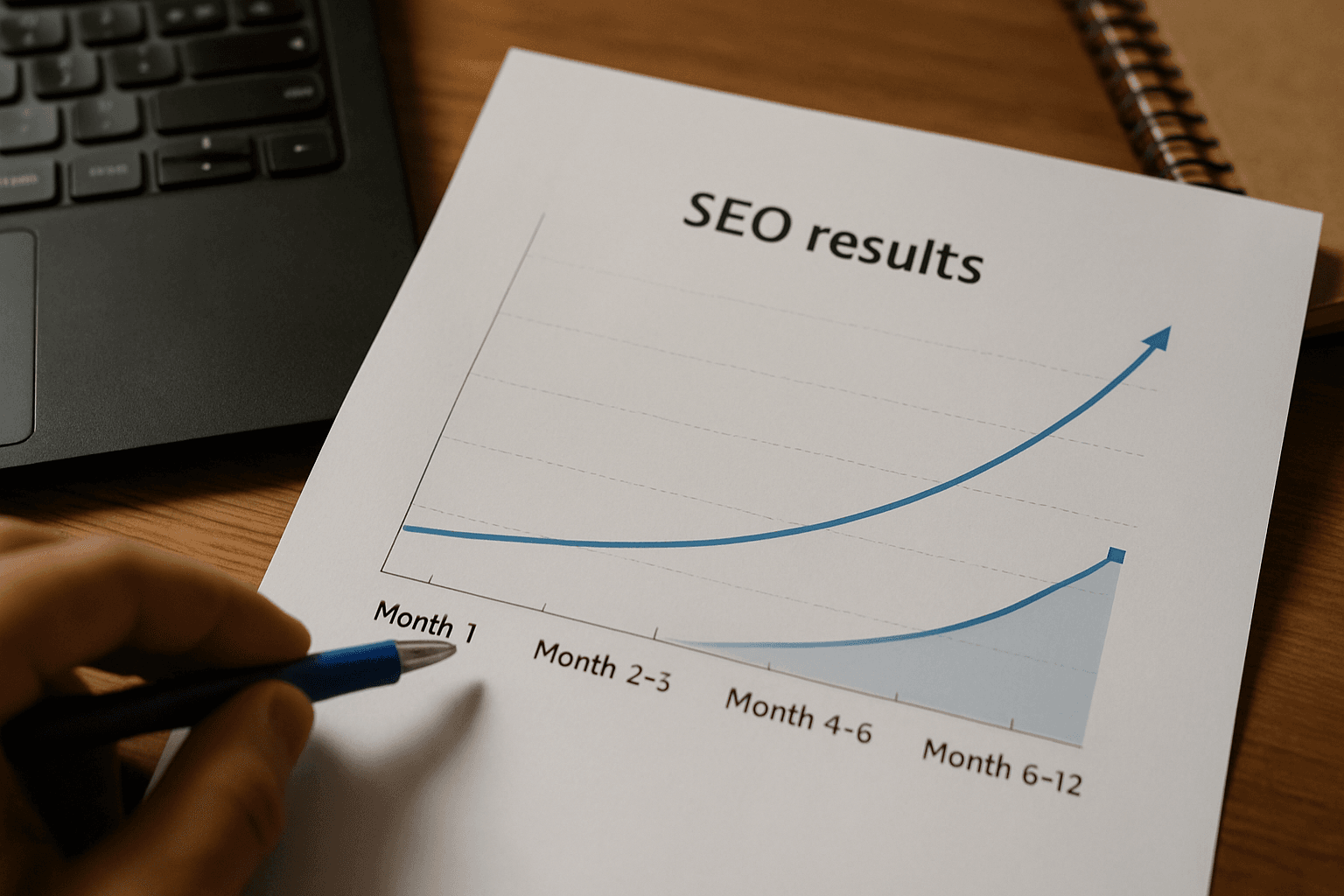
Month 1: The Foundation Phase (Why You'll See Almost Nothing)
The first month is almost entirely invisible from a results perspective, and that's exactly what should happen. You're building infrastructure that search engines need before they can properly evaluate and rank your site. This includes technical fixes like improving page speed, ensuring mobile responsiveness, fixing broken links, and setting up proper site architecture with clear navigation and internal linking.
During this phase, you'll also establish your Google Business Profile if you haven't already, ensuring your NAP information (Name, Address, Phone) is consistent across your website and any existing directory listings. You'll implement basic on-page optimization, updating title tags, meta descriptions, and header structures to target your chosen keywords naturally. You'll set up Google Analytics and Search Console to start gathering baseline data about your current traffic and search performance.
What you won't see is traffic increases or ranking improvements. Maybe you'll notice a few new visitors or a keyword moving from position 95 to position 78, but nothing that feels like progress. This is normal. Google hasn't fully processed your changes yet, and even when it does, it won't immediately trust that your improvements are permanent and valuable. Search engines are conservative by design, rewarding sustained quality over quick changes.
The psychological challenge here is maintaining momentum when analytics show flat lines. Many business owners second-guess their strategy or add more tactics, creating confusion instead of consistency. Resist that urge. Month one is about laying groundwork, not harvesting results. If you're executing the fundamentals correctly, fixing technical issues, optimizing existing content, and establishing your local presence, you're doing exactly what this phase requires.
Months 2-3: The Waiting Game (When Doubt Creeps In)
Months two and three test your patience more than any other period because you're actively creating content and building citations, yet results remain modest. You might see small improvements in SEO results first month tracking, perhaps a few long-tail keywords start appearing in positions 30-50, or your Google Business Profile begins showing in local pack results occasionally. But these wins feel minor compared to the effort you're investing.
During this phase, Google is actively crawling your updated site more frequently, indexing your new content, and beginning to test it in search results. Your pages might appear briefly for certain queries, then disappear, then reappear at different positions. This volatility is Google's algorithm testing user engagement with your content against established competitors. It's measuring click-through rates, time on page, and whether users return to search results or stay on your site.
This is when you should focus on content creation targeting realistic keywords, specific, lower-competition phrases that match actual search intent for your services. Instead of targeting "plumbing services," you'd create content around "how to fix a leaking faucet in [your city]" or "emergency plumber near [neighborhood]." These longer, more specific queries have less competition and allow you to start building topical authority in your niche.
You should also be building local citations by listing your business on reputable directories with consistent NAP information. This signals to Google that your business is legitimate and established, particularly important for local search visibility. The impact won't be dramatic yet, but you're accumulating trust signals that compound over time.
The doubt that creeps in during months two and three is natural, but it's also the point where continuing your strategy matters most. The businesses that break through in months four through six are simply the ones that didn't quit during this phase.
Months 4-6: The Breakthrough Period (Where Patience Pays Off)
Something shifts around month four. The SEO 3 months results you barely noticed start accelerating. Keywords that were ranking in positions 20-30 jump to positions 8-15. Your Google Business Profile appears more consistently in local pack results. Most importantly, you start seeing actual leads, phone calls, contact form submissions, or store visits, that people explicitly mention finding you through Google search.
This breakthrough happens because you've crossed an invisible threshold of trust and relevance in Google's assessment. Your consistent content publication, growing citation profile, and improving user engagement metrics signal that your site deserves higher visibility. The algorithm becomes more confident in showing your pages for target queries, which generates more traffic, which provides more engagement data, which further reinforces your rankings. It's a compounding effect that accelerates once it starts.
Studies tracking small business SEO performance consistently show this pattern. John's Plumbing Services, for example, saw a 50% increase in leads during months four through six after focusing on local citations, NAP consistency, and neighborhood-specific content. The work they did in months one through three created the foundation, but the visible results emerged in this breakthrough period.
By month six, you should expect noticeable increases in organic traffic, often 50-100% above your baseline depending on your starting point and market competition. You'll rank on page one for several long-tail keywords and possibly some moderate-competition terms. Your local listings will drive foot traffic or service calls. The SEO 6 months results should feel substantial enough to justify the effort and investment you've made.
This is also when you'll see which content topics resonate most with your audience. Some pages will perform better than expected, attracting backlinks or social shares naturally. Others might underperform despite optimization. Use this data to refine your content strategy, doubling down on what works and adjusting what doesn't.
Months 6-12: The Compounding Effect (When SEO Finally 'Works')
Between months six and twelve, SEO transitions from a project to a system. Your earlier content continues attracting traffic while new content builds on established topical authority. Keywords that took six months to reach position 10 might climb to positions 3-5. You'll start ranking for more competitive terms you couldn't touch initially. Most significantly, the leads you're generating become consistent and predictable rather than sporadic.
The compounding effect means each new piece of content performs better than previous ones because your domain has accumulated more authority. Internal links from your existing content library boost new pages faster. Your growing backlink profile elevates your entire site. User engagement signals from sustained traffic tell Google your site is increasingly valuable for your topic area.
This is when businesses typically see strong ROI improvements that justify their SEO investment. Instead of paying for each click through advertising, you're receiving consistent organic traffic that costs nothing beyond maintenance. The lifetime value of customers acquired through organic search often exceeds paid channels because these visitors found you by actively searching for solutions you provide, indicating higher intent and better fit.
By month twelve, you should have established rankings for your core service keywords, a steady flow of organic leads, and a content library that continues working for you without constant intervention. You'll still need to maintain your efforts, publishing new content, updating existing pages, managing your local presence, but the relationship between effort and results becomes much more favorable than in the early months.
Understanding this month-by-month progression helps you recognize that SEO isn't broken when results feel slow initially. The timeline reflects how search engines actually work, rewarding sustained quality and consistency over quick tactics. The businesses that succeed with SEO are simply the ones that maintain their strategy through the waiting periods, allowing the compounding effects to emerge naturally.
The 7 Variables That Control Your Timeline (And Which Ones You Can Actually Fix)
Not every small business faces the same SEO timeline, and understanding which variables affect your specific situation helps you set realistic expectations and focus your efforts where they'll matter most.
Your starting point determines everything. A brand-new website with zero domain history faces a longer timeline than an established site that just needs optimization. What affects SEO timeline most dramatically at the beginning is whether Google already knows and trusts your domain. New websites enter what's commonly called the "sandbox period," where Google restricts visibility while assessing whether the site is legitimate and valuable. This can add two to four months to your timeline compared to an established domain. If you're starting from scratch, accept this reality and use the time to build a strong content foundation rather than expecting immediate rankings.
Market competition creates different playing fields entirely. Targeting "divorce attorney" in a major metropolitan area means competing against law firms with million-dollar SEO budgets, established domain authority, and hundreds of backlinks. The same business targeting "collaborative divorce mediation in [small town]" faces dramatically less competition and can achieve visibility much faster. You can't eliminate competition, but you can choose your battles strategically by targeting longer, more specific keywords where you can actually compete. This is the most actionable variable you control, picking realistic keyword targets based on honest assessment of your competitive position.
Technical foundation issues add months if ignored. A slow-loading website, poor mobile experience, broken navigation, or crawl errors forces Google to work harder to access and understand your content. These technical problems don't just delay results, they actively prevent Google from properly evaluating your site. The good news? Technical issues are entirely fixable. Run your site through Google's PageSpeed Insights and Mobile-Friendly Test. Fix what they identify as problems. Ensure your site loads in under three seconds on mobile devices. Make sure every page is accessible within three clicks from your homepage. These fixes might take a few weeks but can shave months off your overall timeline by removing barriers to indexing and ranking.
Content quality and quantity create your competitive edge. Publishing one blog post per month won't compete against businesses publishing weekly. Thin, generic content won't outrank comprehensive, specific resources that actually answer user questions thoroughly. This variable is entirely within your control and offers the highest return on effort. Focus on creating content that's genuinely more useful than what currently ranks, longer, more detailed, better organized, with clearer explanations and practical examples. Quality matters more than quantity, but you need both consistency and excellence to build topical authority over time.
Local versus national targeting shifts timelines dramatically. Local SEO for small businesses typically shows results faster because you're competing in a geographically limited market and Google prioritizes local results for location-based searches. If you're a service business serving a specific area, optimizing for local search (Google Business Profile, local citations, location-specific content) delivers results in three to six months more reliably than targeting national keywords. This is why SEO results new website often come faster for local businesses than e-commerce or national service providers, the competitive scope is naturally limited.
Your industry's content velocity matters more than you'd think. Some industries publish constantly (marketing, technology, finance), creating environments where fresh content is expected and rewarded. Others move slowly (manufacturing, traditional services), where comprehensive evergreen content can rank for years without updates. Understanding your industry's content expectations helps you gauge how often you need to publish and update content. In fast-moving industries, you might need weekly publication to maintain visibility. In slower industries, monthly comprehensive guides might suffice. This isn't entirely controllable, but adapting your strategy to match industry norms accelerates results.
Link building speed and quality determine authority accumulation. Backlinks remain a critical ranking factor, but acquiring them takes time. Natural link building, where other sites link to your content because it's genuinely valuable, happens slowly but creates lasting authority. Aggressive link building through outreach or partnerships can accelerate timelines but requires careful quality control to avoid spammy links that harm rather than help. For most small businesses, focusing on creating linkable content (original research, comprehensive guides, local resources) and building relationships with local business associations, chambers of commerce, and industry partners provides the most sustainable approach. This variable is partially controllable through strategy but can't be rushed without risk.
The honest assessment is that you control three to four of these seven variables significantly. You can't change your competitive landscape overnight or manufacture domain authority instantly, but you can fix technical issues, create excellent content consistently, optimize for local search effectively, and build quality links strategically. Focusing your limited time and resources on these controllable variables delivers the best timeline improvements. Worrying about variables you can't control wastes energy that could go toward execution.
How long does Google SEO take when you optimize these controllable variables? For most small businesses, the realistic timeline compresses from twelve months to six months when you execute well on technical foundation, content quality, local optimization, and strategic keyword targeting. You won't beat the fundamental reality that search engines need time to assess and trust your site, but you can avoid the delays that come from technical problems, poor content, or unrealistic keyword targeting.
How to Speed Up Results Without Spending Thousands on an Agency
Most small business owners assume they need to hire an expensive SEO agency to see results, but the mechanics of how to speed up SEO results are more accessible than you might think. The key is understanding which tactics deliver disproportionate impact and focusing your limited time there.
Local SEO basics deliver the fastest returns for service businesses. If you serve customers in a specific geographic area, optimizing your Google Business Profile should be your absolute first priority. This single action can generate visibility and leads within weeks, not months, because Google heavily weights local business information for location-based searches. Claim your profile if you haven't already, then fill out every section completely, business hours, service areas, categories, attributes, photos, and a detailed business description using natural language about what you do and where you serve.
The mistake most businesses make is treating their Google Business Profile as a one-time setup task. The businesses that achieve faster SEO results treat it as an active marketing channel. Post updates weekly, photos of completed projects, special offers, helpful tips, or business news. Respond to every review, both positive and negative, within 24-48 hours. Add new photos regularly showing your work, your team, and your location. These activities signal to Google that your business is active and engaged, which improves your visibility in local pack results where many purchase decisions happen.
Strategic content targeting accelerates visibility more than volume. Instead of publishing generic blog posts hoping something ranks, identify the specific questions your ideal customers ask before hiring someone like you. Use Google's autocomplete feature, type your service plus question words (how, why, when, what) and see what Google suggests. These suggestions represent actual searches people perform. Create comprehensive content answering these specific questions better than existing results. A single excellent piece of content targeting a realistic keyword can generate more traffic than ten mediocre posts targeting competitive terms.
The SEO timeline without agency support shortens dramatically when you focus on long-tail, high-intent keywords rather than broad competitive terms. "Emergency plumber cost" is more achievable and valuable than "plumber." "How to choose a divorce attorney" attracts better prospects than "attorney." These longer, more specific phrases have less competition, clearer search intent, and higher conversion rates. You can realistically rank for several of these within three to four months rather than waiting a year for broader terms.
Citation building creates trust signals faster than link building. For local businesses, getting listed on relevant directories with consistent NAP information (Name, Address, Phone) delivers quicker local SEO impact than chasing backlinks from blogs or news sites. Focus on the major platforms first, Google Business Profile, Bing Places, Apple Maps, Yelp, and industry-specific directories relevant to your business. Then expand to local chambers of commerce, business associations, and community sites. The key is absolute consistency in how you list your business information across every platform. Even small variations (Street vs St, Suite vs Ste) can dilute the trust signals these citations create.
This tactic is particularly effective for SEO without hiring agency because it's straightforward, doesn't require technical skills, and delivers measurable local visibility improvements within two to three months. Small businesses implementing systematic citation building consistently report increased local pack appearances and map visibility within this timeframe.
Review generation accelerates trust and visibility simultaneously. Customer reviews on your Google Business Profile and other platforms serve dual purposes, they influence potential customers directly and they signal to Google that your business is active, trusted, and worthy of visibility. Businesses with consistent positive reviews rank higher in local results than competitors with fewer or older reviews, even when other factors are similar. Implement a systematic process for requesting reviews from satisfied customers immediately after service completion. Make it easy with direct links to your review profiles. Respond to every review to show engagement and build social proof.
Technical quick wins remove barriers immediately. You don't need to become a technical expert to fix the most common issues that slow SEO results. Use free tools like Google's PageSpeed Insights to identify specific problems affecting your site speed and mobile performance. Often the biggest issues are oversized images, unnecessary plugins, or poor hosting. Compressing images alone can improve load times by 50% or more. Switching from shared hosting to managed WordPress hosting or a modern hosting provider can cut load times from five seconds to under two seconds, which directly impacts rankings and user experience.
Automation tools compress execution time without sacrificing quality. The traditional barrier to DIY SEO has been the time required for keyword research, content planning, and consistent publication. Modern AI-driven SEO platforms can automate much of this work while maintaining quality standards. Systems like SEO Siah handle keyword research, content strategy, and even content generation with E-E-A-T optimization built in, allowing you to maintain consistent publication schedules without spending 20 hours per week on content creation. This doesn't replace strategic thinking, but it removes the execution bottleneck that prevents most small business owners from maintaining the consistency SEO requires.
The honest truth about faster SEO results is that you can't bypass the fundamental timeline search engines require to assess and trust your site, but you can avoid the delays that come from poor execution, technical problems, or unfocused strategy. Focusing on these high-impact tactics, local optimization, strategic content, citation building, review generation, and technical quick wins, typically compresses a twelve-month timeline to six months for small businesses willing to execute consistently.
Your Next 30 Days: The SEO Starter Plan That Actually Moves the Needle
You understand the timeline now, and you know which variables you can control. Here's exactly what to do in the next 30 days to start building momentum, whether you're starting from scratch or reviving a neglected website.
Week 1: Foundation and Assessment. Begin by claiming and fully optimizing your Google Business Profile if you haven't already. This single action delivers the fastest potential returns for local businesses. Fill out every section completely, don't skip attributes, hours, or service areas. Add at least ten high-quality photos showing your work, your team, and your location. Write a detailed business description using natural language about what you do, who you serve, and what makes you different.
Next, audit your website's technical health using free tools. Run your site through Google's PageSpeed Insights and Mobile-Friendly Test. Note any critical issues affecting load speed or mobile usability. Check Google Search Console for crawl errors, indexing issues, or security problems. You don't need to fix everything immediately, but identify the most critical issues that actively prevent Google from properly accessing your site. These might include broken navigation, slow load times over five seconds, or pages blocked from indexing.
Set up or verify your Google Analytics and Search Console if you haven't already. These free tools provide the data you need to track progress and make informed decisions. Without baseline metrics, you can't measure improvement or identify what's working.
Week 2: Content Strategy and Quick Wins. Identify five to seven realistic keyword targets based on what your ideal customers actually search for before buying. Use Google's autocomplete feature and the "People also ask" section to find specific questions people ask about your services. Prioritize longer, more specific phrases (four to seven words) over broad competitive terms. These long-tail keywords have clearer intent, less competition, and higher conversion rates.
Create a simple content calendar mapping these keywords to specific articles or pages you'll create over the next three months. This doesn't need to be elaborate, a simple spreadsheet listing the keyword, article title, and target publication date provides enough structure to maintain consistency.
Fix your most critical technical issues identified in week one. If your site loads slowly, compress your images using free tools like TinyPNG or ShortPixel. If your mobile experience is poor, consider switching to a responsive theme or contacting your web developer for fixes. If you have broken links or navigation issues, fix them immediately. These quick wins remove barriers that actively prevent SEO progress.
Week 3: Content Creation and Local Presence. Write and publish your first piece of comprehensive content targeting one of your identified keywords. Focus on creating something genuinely more useful than what currently ranks, longer, more detailed, better organized, with clear explanations and practical examples. Aim for 1,500-2,500 words that thoroughly answer the question or topic. Include relevant images, clear headings, and a logical structure that's easy to scan.
Begin building your local citation profile by listing your business on major directories: Bing Places, Apple Maps, Yelp, and two to three industry-specific directories relevant to your business. Ensure your NAP information (Name, Address, Phone) is exactly identical across every listing and matches what's on your website. Even small inconsistencies dilute the trust signals these citations create.
Implement a review generation process. Create a simple email template you can send to satisfied customers asking for a Google review, including a direct link to your review profile. Make it part of your standard post-service follow-up. The goal isn't to pressure customers but to make leaving a review easy for those already inclined to do so.
Week 4: Momentum and Automation. Publish your second piece of content targeting another keyword from your list. Establishing a consistent publication rhythm matters more than perfection. If you can maintain weekly publication, do it. If monthly is more realistic, commit to that. Consistency builds topical authority and signals to Google that your site is actively maintained.
Consider implementing an automated SEO platform to maintain momentum beyond this initial 30 days. Small business SEO without agency support often fails not because of strategy but because of execution consistency. Business owners get busy, content creation falls behind, and momentum stops. Modern AI-driven SEO tools like SEO Siah can automate keyword research, content planning, and even content generation while maintaining quality standards, allowing you to focus on running your business while maintaining the SEO consistency that drives results.
Set up a simple tracking system to monitor your progress. Create a spreadsheet listing your target keywords and check their rankings monthly using free tools like Google Search Console. Track your Google Business Profile views and actions monthly. Monitor your organic traffic in Google Analytics. These simple metrics show whether your efforts are working and help you adjust strategy based on actual data rather than guesses.
This 30-day plan establishes the foundation that allows SEO to work over the following months. You've optimized your local presence, fixed critical technical issues, created initial content, built citation signals, and established systems for consistency. The results won't be dramatic yet, remember, months one through three show minimal visible progress, but you've started the compounding process that delivers substantial results in months four through six.
The businesses that succeed with SEO without technical knowledge or massive budgets are simply the ones that execute these fundamentals consistently over time. They don't have secret tactics or insider connections. They understand the timeline, focus on controllable variables, and maintain effort through the waiting periods when results feel slow. The next 30 days won't transform your business, but they'll start the process that does. The question is whether you'll maintain that process long enough to see the compounding effects emerge.
| Business | Industry | Timeline | Strategy Focus | Results Achieved |
|---|---|---|---|---|
| Betty's Bakery | Local Retail/Food | 3-6 months | Google Business Profile optimization, customer reviews, regular posting | 200% increase in local search visibility and foot traffic |
| John's Plumbing Services | Local Services | 6 months | Local citations, NAP consistency, neighborhood-targeted content | 50% increase in leads |
| Storylane | B2B SaaS | 5-6 months | Targeted content creation, clean site architecture | 201% organic traffic growth, 140+ new customers |
| BizIQ Client Examples | Various Small Business | 3-6 months | Web optimization, content strategy, local listings | Meaningful ranking improvements and lead generation |
Conclusion
So, how long does SEO take for small business? If you came here hoping for a magic number, you've probably realized by now that the real answer is more nuanced, and more useful, than "three months" or "six months." The timeline depends on where you're starting, how competitive your market is, the quality of your execution, and how consistently you show up.
What we've explored here isn't guesswork. It's drawn from patterns observed across hundreds of small business SEO campaigns: the businesses that see traction in 3–6 months are typically those starting with some authority, targeting smart keywords, and executing well. Those facing 6–12 months or longer are often in tougher markets, starting from zero, or recovering from past mistakes. And the ones that stall? They're usually inconsistent, chasing tactics instead of strategy, or expecting overnight wins in a game built on compounding effort.
The truth is, SEO rewards patience and precision. It's not about gaming the system, it's about building something Google and your customers trust. That means publishing helpful content regularly, earning credible backlinks, fixing technical issues as they arise, and staying committed even when the first few months feel quiet. The businesses that treat SEO like a long-term asset, not a short-term campaign, are the ones that eventually dominate their local or niche markets.
If you're a small business owner, this can feel overwhelming. You're already wearing a dozen hats, and now you're supposed to become an SEO expert too? That's where smart automation comes in. Tools like SEO Siah are designed to handle the heavy lifting, keyword research, content planning, article generation, even publishing, so you can focus on running your business while your SEO runs in the background. It's built for business owners who want results without needing to learn the technical weeds, and for agencies or specialists who want to scale their output without sacrificing quality.
The bottom line: SEO takes time, but it doesn't have to take all your time. Set realistic expectations, commit to consistency, and use the right systems to keep momentum going. Six months from now, you'll be glad you started today, just like that 2 AM search that brought you here was the first step toward understanding what actually works.
Related Articles
- Case Studies in Local SEO: How Small Businesses Are Ranking Without Big Budgets
- SEO Case Studies: Real Results from Small Business Campaigns
Frequently Asked Questions
How long does it take to see SEO results for a brand new small business website?
For a brand new website with zero domain history, expect 6-12 months before seeing substantial SEO results. New sites enter what's called a "sandbox period" where Google restricts visibility while assessing legitimacy. During the first 3-4 months, you'll see minimal traffic increases as Google crawls and indexes your content. Months 4-6 typically bring the first meaningful improvements, long-tail keyword rankings and occasional local pack appearances. By months 6-12, you should see consistent organic traffic and rankings for your target keywords. The timeline can compress to 4-6 months if you focus aggressively on local SEO, build citations quickly, and create high-quality content targeting low-competition keywords from day one.
Can I speed up SEO results without hiring an expensive agency?
Yes, absolutely. The mechanics of SEO don't change based on who implements them, agencies simply have more resources for execution. You can accelerate results by focusing on high-impact tactics: optimize your Google Business Profile completely (this alone can generate leads within weeks for local businesses), build local citations with consistent NAP information across directories, create comprehensive content targeting specific long-tail keywords with clear search intent, generate customer reviews systematically, and fix critical technical issues like slow page speed. Modern SEO automation tools can also help maintain consistency without requiring 20+ hours per week. The key is strategic focus on controllable variables rather than trying to do everything at once. Most small businesses can compress a 12-month timeline to 6 months through smart prioritization and consistent execution.
Why does SEO take so long compared to paid advertising?
SEO takes longer because search engines need time to assess trust and relevance before promoting your content. Unlike paid ads where you immediately buy visibility, organic rankings require Google to crawl your pages, compare them against competitors, test them in search results, measure user engagement, and gradually build confidence that your content deserves higher positions. This process is intentionally conservative, Google prioritizes user experience over quick rankings. Additionally, SEO requires accumulating trust signals over time: consistent content publication, growing backlink profiles, positive user engagement metrics, and established domain authority. These factors compound gradually rather than switching on instantly. The tradeoff is that while paid ads stop generating traffic the moment you stop paying, SEO continues delivering results long after the initial work is done, often at a much lower cost per acquisition over time.
What are realistic SEO results to expect after 3 months for a small business?
After 3 months of consistent SEO effort, realistic expectations include: several long-tail keywords ranking in positions 20-50, your Google Business Profile appearing occasionally in local pack results (if you're a local business), 20-40% increase in organic traffic from your baseline (though this might still be modest in absolute numbers), improved indexing of your pages in Google Search Console, and possibly your first few leads explicitly mentioning they found you through Google search. You won't typically rank on page one for competitive terms yet, and traffic increases will feel incremental rather than dramatic. This is the "waiting game" phase where doubt creeps in, but it's also when the foundation you've built starts showing early signals. The businesses that break through in months 4-6 are the ones that maintain their strategy during this period rather than abandoning it due to seemingly slow progress.
How does local SEO timeline differ from national SEO for small businesses?
Local SEO typically delivers results 2-3 months faster than national SEO because you're competing in a geographically limited market and Google prioritizes local results for location-based searches. A local service business can often see meaningful visibility improvements within 3-4 months through Google Business Profile optimization, local citations, and neighborhood-specific content. National SEO faces broader competition and requires building more substantial domain authority, often taking 6-12 months for significant results. Local SEO also benefits from lower keyword difficulty, "plumber in [city]" is far easier to rank for than "best plumbing services" nationally. Additionally, local pack results (the map listings that appear for local searches) can generate leads even when your website doesn't rank on page one organically. For small businesses serving specific geographic areas, focusing on local SEO first provides the fastest return on effort and investment.
What factors can delay my small business SEO timeline?
Several factors commonly delay SEO timelines for small businesses: technical issues like slow page speed (over 3 seconds), poor mobile experience, or crawl errors that prevent Google from properly accessing your site; inconsistent NAP information across your website and directory listings, which dilutes trust signals; targeting overly competitive keywords instead of realistic long-tail terms you can actually rank for; publishing thin, generic content that doesn't outperform what already ranks; inconsistent content publication that signals your site isn't actively maintained; lack of local citations and reviews for local businesses; and starting with a brand new domain that enters the Google sandbox period. The good news is that most of these factors are controllable, fixing technical issues, building consistent citations, creating quality content, and targeting strategic keywords can compress your timeline significantly. The delays that hurt most are the ones caused by giving up too early or constantly switching strategies before they have time to work.