DIY SEO Timeline: Real Hours Needed for Results
You've finally decided to tackle SEO yourself, no agency retainers, no expensive consultants. You carve out a Saturday afternoon, optimize a few page titles, publish a blog post, and then... wait. A week passes. Two weeks. A month. Your Google Analytics flatlines. The question gnawing at you isn't if SEO works, it's how long this DIY SEO timeline actually stretches before you see a single lead.
Here's the truth most "SEO made easy" guides conveniently skip: meaningful results from do-it-yourself SEO typically demand 6-12 months of consistent effort, not the "rank in 30 days" fantasy peddled across social media. And if you're a busy business owner squeezing optimization into evenings and weekends, that timeline gets murkier. You're not just competing against algorithm updates, you're battling site age penalties, keyword difficulty curves, and the compounding nature of authority-building that rewards persistence over quick wins.
But understanding how long does SEO take isn't about discouragement, it's about realistic planning. When you know that local visibility might surface in 1-3 months while competitive rankings need closer to a year, you stop second-guessing your strategy every time traffic dips. This article breaks down the month-by-month reality of DIY SEO timelines, drawing from agency data and real small business case studies. You'll learn which early signals actually matter, how to prioritize when time is scarce, and what "compounding results" genuinely looks like beyond the buzzword.
The Brutal Truth About DIY SEO Time Investment (That Most Guides Won't Tell You)
Here's what nobody wants to tell you about DIY SEO: it's not the quick weekend project those "SEO in 30 days" courses promise. The realistic DIY SEO timeline involves consistent, focused work spread across months, not hours. If you're a business owner squeezing SEO between customer calls and inventory management, you need to understand the actual SEO time investment before you dive in. Most guides gloss over this reality because honesty doesn't sell courses, but understanding the true commitment helps you make smarter decisions about whether to tackle SEO yourself or find alternatives.
The DIY SEO timeline breaks down into distinct phases, each with different demands on your schedule. During the foundation phase, you're essentially building the infrastructure that makes everything else possible. Think of it like renovating a house, you can't skip the electrical work and plumbing just because you're excited to paint the walls. This initial setup requires concentrated effort, but it's front-loaded. Once you've established the basics, the ongoing time commitment shifts from intensive setup to consistent maintenance and content creation. The key is knowing what to expect at each stage so you can plan realistically around your existing responsibilities.
What makes this particularly challenging for business owners is that SEO demands both quality and consistency. You can't batch all your SEO work into one marathon month and expect results. Search engines reward sites that demonstrate ongoing activity, fresh content, and continuous improvement. This means integrating SEO into your weekly routine, not treating it as a one-time project. According to industry research on SEO timelines, most businesses see meaningful results only after six to twelve months of consistent effort, and that consistency is where most DIY attempts fail.
Month 1-3: The Foundation Phase (15-20 Hours Initial Setup)
The first three months of your DIY SEO timeline are the most time-intensive, requiring roughly fifteen to twenty hours of concentrated work upfront. This isn't time you can easily split into fifteen-minute chunks between meetings. You need focused blocks to conduct a proper site audit, identify technical issues, and establish your keyword strategy. During this phase, you're essentially diagnosing your website's current health and creating the roadmap for everything that follows.
Your primary tasks during these initial months center on technical SEO and strategic planning. Start with a comprehensive site audit using free tools like Google Search Console and Google's PageSpeed Insights. You're looking for broken links, slow-loading pages, mobile responsiveness issues, and indexation problems, the foundational elements that prevent search engines from properly crawling and ranking your site. Many business owners skip this step and jump straight to content creation, which is like planting seeds in concrete. Fix the technical foundation first, and you'll see results from your content efforts much faster. Research shows that addressing technical SEO issues can yield visible improvements in one to three months, making this the fastest path to early wins.
Simultaneously, you need to invest time in keyword research, the strategic backbone of your entire SEO effort. This means identifying the specific phrases your potential customers use when searching for your products or services. For busy owners, focus on low-competition, long-tail keywords that match your local market. A plumber in Austin shouldn't target "plumbing services" nationally; instead, phrases like "emergency pipe repair Austin" or "water heater installation near me" offer realistic ranking opportunities within three to six months. Spend at least five hours researching and documenting twenty to thirty target keywords, then map them to specific pages on your site or content you plan to create.
The final component of this foundation phase involves optimizing your existing pages. Update title tags, meta descriptions, header tags, and on-page content to align with your keyword research. This isn't about stuffing keywords everywhere, it's about ensuring each page clearly communicates its topic to both users and search engines. For a ten to twenty-page website, expect to spend six to eight hours on these optimizations. Yes, it's tedious work, but these changes often produce the first measurable improvements in your search impressions and click-through rates, giving you early momentum to stay motivated through the longer journey ahead.
Month 3: You're checking rankings daily, wondering if that blog post will ever crack page 2. Your Google Search Console shows impressions climbing from 50 to 200 per week, not traffic yet, but proof Google is noticing. You're tempted to quit, but those small signals keep you going.
Month 4-6: The Content Grind (5-10 Hours Weekly)
Once your foundation is solid, the DIY SEO timeline shifts into what I call the content grind, a phase that separates successful SEO efforts from abandoned ones. This is where you need to commit five to ten hours weekly to creating, publishing, and promoting content. Notice I said weekly, not monthly. Consistency matters more than volume here. Publishing two well-optimized blog posts per month consistently beats publishing eight posts one month and then nothing for three months. Search engines interpret regular activity as a signal that your site is active, maintained, and worthy of attention.
Your content during this phase should target the keywords you identified in months one through three, but with a strategic approach. Focus on answering specific questions your customers ask. If you run a bakery, don't write generic posts about "how to bake bread", that's too competitive and too broad. Instead, create content around "gluten-free wedding cake options in [your city]" or "how to order custom birthday cakes for delivery." These specific, intent-driven topics attract qualified traffic that actually converts into customers. Each piece should be thoroughly researched, genuinely helpful, and optimized with your target keyword naturally woven throughout. Plan for three to four hours per article, including writing, editing, adding images, and basic on-page SEO.
Beyond content creation, this phase demands consistent work on local SEO if you serve a specific geographic area. Claim and fully optimize your Google Business Profile, which research indicates can produce visibility improvements within one to three months. Post weekly updates, respond to reviews, add photos, and ensure your business information is accurate across all online directories. This work takes about two hours weekly but delivers disproportionate results for local businesses. Many owners see their first phone calls and customer inquiries from organic search during this phase, particularly for location-based queries.
The hardest part of the content grind isn't the work itself, it's maintaining momentum when you don't see immediate results. During months four through six, you're building authority and trust with search engines, but traffic increases may still feel modest. Track your progress through metrics like search impressions and average position in Google Search Console rather than obsessing over traffic numbers. Seeing your content appear for more queries, even if it's ranking in positions fifteen through thirty initially, confirms you're moving in the right direction. This is the phase where most DIY efforts fail because owners get discouraged and stop, but pushing through these months is exactly what separates sites that eventually rank from those that never gain traction.
Month 5: A customer mentions they found you on Google. Just one. But it's the first organic lead you've gotten, and suddenly those five hours per week feel worth it. You double down on content, energized by that single conversion.
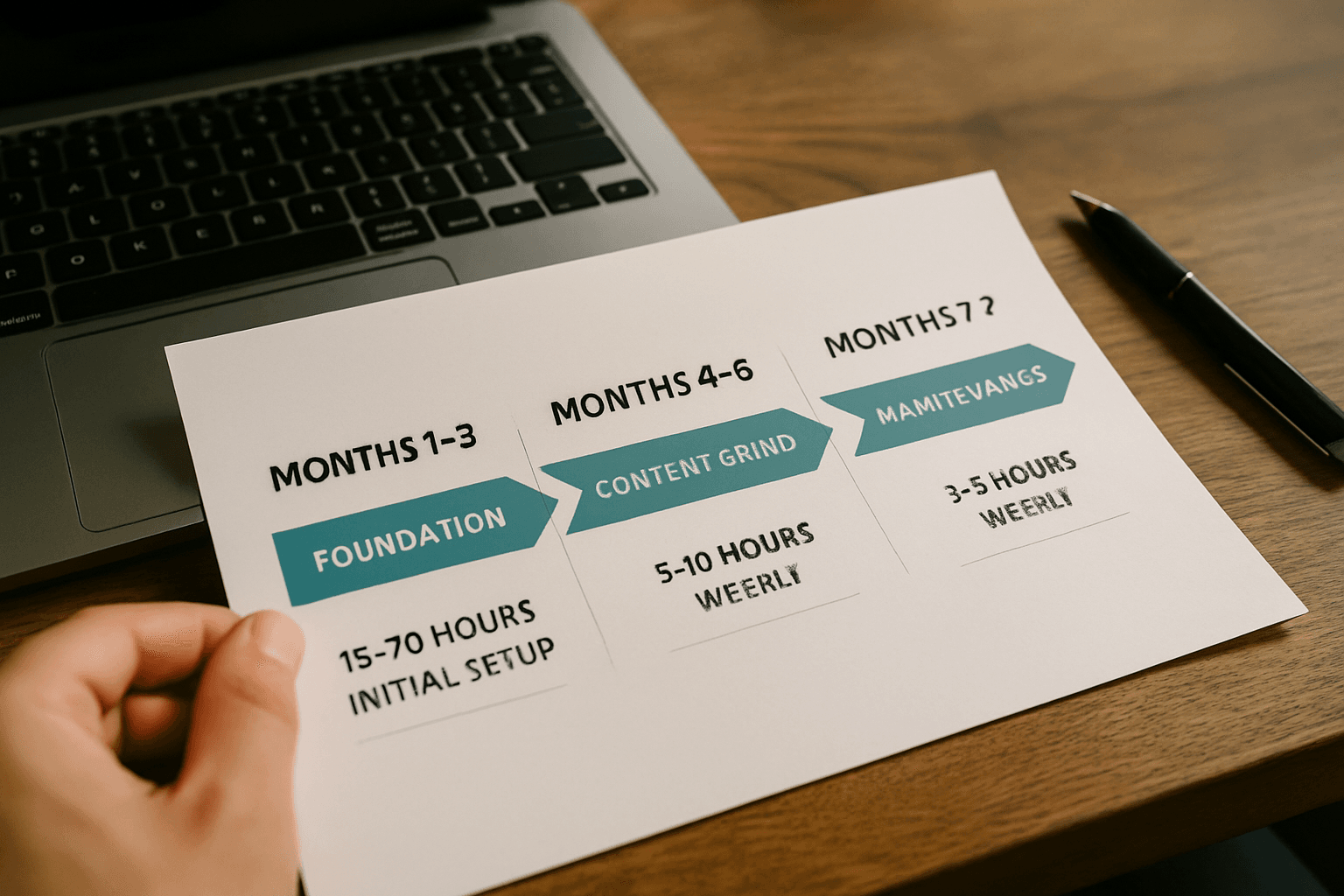
Month 7-12: The Maintenance Reality (3-5 Hours Weekly)
After six months of consistent effort, your DIY SEO timeline enters a maintenance phase that still requires three to five hours weekly, but the nature of the work changes. You're no longer building from scratch; you're optimizing what exists, scaling what works, and monitoring performance. This is when compounding effects start to kick in. The content you published in months four through six begins ranking better, backlinks you built start passing authority, and your domain gains trust with search engines. According to SEO experts tracking client results, this six to twelve-month window is when most sites transition from "building" to "growing."
Your primary focus during this phase shifts to analyzing what's working and doubling down on successful strategies. Use Google Search Console and Google Analytics to identify which pages attract the most impressions and clicks, then create additional content around related topics. If your article about "emergency plumbing repairs" ranks well and drives calls, expand that success with related content like "how to prevent pipe bursts in winter" or "signs you need emergency plumbing service." This topical clustering signals to search engines that you're an authority on the subject, boosting rankings for all related pages. Spend about two hours weekly analyzing performance data and planning content based on those insights rather than guessing what might work.
Content refreshing becomes increasingly important during this phase. Your older articles from months three through six may need updates to maintain or improve their rankings. Search engines favor fresh, current content, so revisiting your existing posts every few months to add new information, update statistics, or improve formatting can yield significant ranking improvements. This maintenance work is often more efficient than creating entirely new content because you're building on pages that already have some authority. Allocate one to two hours weekly to refreshing older content, prioritizing pages that already rank on page two of search results, these are your quickest wins for moving into the top ten positions.
Finally, this phase requires ongoing link building and relationship development, which many DIY owners neglect. You don't need hundreds of backlinks, but you do need quality links from relevant, authoritative sites in your industry or location. Reach out to local business associations, industry blogs, or complementary businesses for guest posting opportunities or partnership mentions. Even one to two quality backlinks per month compounds over time, significantly boosting your domain authority. This outreach work takes about one to two hours weekly and feels less urgent than content creation, but it's often the difference between ranking on page one versus page two for competitive terms. The businesses that commit to this maintenance reality through month twelve and beyond are the ones that eventually reduce their reliance on paid advertising and build sustainable organic traffic.
Month 10: Your analytics show organic traffic has tripled from month one. You're getting 3-5 qualified leads per week from search. The Saturday afternoons you invested are now paying dividends while you sleep.
Why Busy Business Owners Fail at SEO (And What Actually Works Instead)
The primary reason business owners fail at DIY SEO isn't lack of intelligence or capability, it's the fundamental mismatch between what SEO demands and what busy owners can realistically deliver. SEO for busy owners requires consistent, strategic effort over months, but business owners operate in a world of urgent customer needs, operational fires, and immediate revenue demands. When your HVAC system breaks down on the busiest day of the year, updating your blog post about seasonal maintenance tips drops to the bottom of your priority list. This isn't a failure of commitment; it's the reality of running a business where SEO competes with dozens of more urgent tasks that directly impact your ability to operate today.
The second major failure point is the learning curve that most guides underestimate. SEO isn't a single skill, it's a collection of interconnected disciplines including technical website optimization, content strategy, keyword research, link building, analytics interpretation, and competitive analysis. Each of these areas has its own best practices, tools, and nuances. A business owner who excels at customer service, inventory management, or product development must now become proficient in a completely different domain that changes constantly as search algorithms evolve. The SEO time investment isn't just in doing the work; it's in learning how to do the work correctly, which often doubles the actual hours required.
What actually works for busy owners is acknowledging these constraints upfront and building SEO strategies around them rather than against them. This means focusing ruthlessly on high-impact activities that match your available time and accepting that a focused, narrow SEO approach beats an abandoned comprehensive one. For most small business owners, this translates to prioritizing local SEO and long-tail keywords where competition is lower and results come faster. Instead of trying to rank nationally for "accounting services," focus on "small business tax preparation in [your neighborhood]." The narrower focus requires less content, less technical sophistication, and less ongoing maintenance, making it actually achievable for SEO for busy owners within realistic time constraints.
The other strategy that works is systematizing SEO into repeatable, scheduled blocks rather than treating it as an ongoing, ambiguous task. Designate specific times each week for SEO work, maybe two hours every Monday morning before customer calls start, or one hour every Tuesday and Thursday afternoon. During these blocks, work through a simple checklist: check Google Business Profile messages and reviews, publish or update one piece of content, monitor rankings for your top five keywords, and respond to any technical issues flagged in Google Search Console. This systematic approach prevents SEO from becoming an overwhelming, undefined burden and transforms it into a manageable routine for busy owners. Research on SEO timelines consistently shows that regular, modest effort outperforms sporadic intensive work because search engines reward ongoing activity and freshness.
The final piece that works is recognizing when DIY SEO stops making economic sense for your business. If you bill clients at $150 per hour for your professional services, spending ten hours weekly on SEO costs you $1,500 in opportunity cost, money you could have earned serving customers. At that point, paying a specialist or using automation tools becomes not just easier but financially smarter. The most successful business owners I've observed treat SEO as they would any other business function: they start by understanding it themselves, then systematize or delegate it as soon as the economics justify it. The goal isn't to become an SEO expert; it's to generate more qualified leads and customers for your business through organic search. Sometimes the smartest path to that goal doesn't involve doing everything yourself, it's about minimizing your SEO time investment while maximizing results.
The Smart Owner's Shortcut: Automation vs Manual SEO Time Comparison
The debate between automated SEO and manual DIY efforts ultimately comes down to a simple calculation: what's your time worth, and how quickly do you need results? Manual SEO, as we've established, requires fifteen to twenty hours initially and three to ten hours weekly ongoing, that's roughly 200 to 400 hours in the first year. If your billable rate or opportunity cost is $100 per hour, you're investing $20,000 to $40,000 in time value for DIY SEO. Automated SEO tools and platforms condense this timeline dramatically by handling the repetitive, technical, and research-intensive tasks that consume most of your hours. The question isn't whether automation is faster, it objectively is, but whether it delivers comparable quality and results for SEO for busy owners.
Modern automated SEO platforms like SEO Siah represent a fundamental shift in how business owners can approach organic search. Instead of manually conducting keyword research, these systems use AI to analyze search trends, competition, and relevance, delivering targeted keyword opportunities in minutes rather than hours. Instead of manually writing and optimizing each blog post, automated content creation creates SEO-optimized articles based on your business focus and target keywords, maintaining quality while eliminating the three to four hours per article you'd spend writing manually. For technical SEO, automation handles site audits, identifies issues, and often integrates directly with your WordPress or CMS to implement fixes, work that would take you hours to learn and execute manually. This dramatically reduces SEO time investment while maintaining quality.
The time comparison becomes stark when you map specific tasks. Manual keyword research for twenty to thirty target phrases requires five to eight hours of work using free tools, analyzing competition, and documenting opportunities. Automated platforms complete this in ten to fifteen minutes with often superior data because they access larger datasets and more sophisticated competitive analysis. Manual content creation, researching, writing, optimizing, and publishing one 1,500-word article, takes three to four hours for most business owners. Automated generation produces comparable content in five to ten minutes, allowing you to review and customize rather than create from scratch. Link building and outreach, which manually demands one to two hours weekly, can be partially automated through relationship management tools and templated outreach, reducing your SEO time investment to reviewing opportunities rather than finding them.
For business owners specifically, automation addresses the consistency problem that derails most DIY efforts. You don't need to remember to update your content calendar or manually check rankings each week, the system handles ongoing monitoring, alerts you to issues, and maintains the regular publishing schedule that search engines reward. SEO Siah, for instance, automates the entire content ecosystem from keyword research through publishing, meaning you can maintain a consistent SEO presence even during your busiest operational periods. This consistency is what transforms SEO from a time-intensive project you eventually abandon into a sustainable growth engine that runs with minimal ongoing input, perfect for SEO for busy owners.
The honest assessment, though, is that automation isn't a complete replacement for strategic thinking, it's a force multiplier for it. You still need to understand your business positioning, your ideal customer, and your competitive advantages. Automation handles the execution and optimization, but you provide the strategic direction. For SEO specialists and agencies, platforms like SEO Siah function as production engines that let them manage more clients with consistent quality, using the time savings to focus on strategy, client relationships, and custom optimizations. For business owners, the value proposition is even clearer: invest two to three hours monthly reviewing automated output and providing strategic guidance, versus ten to twenty hours weekly doing everything manually. That time difference, roughly 90% reduction in hands-on work, is what makes automation not just convenient but economically essential for SEO for busy owners whose expertise and value creation happens in their business, not in SEO execution.
The ultimate decision between DIY and automated SEO depends on your specific situation, but the calculation is straightforward. If you have more time than money, enjoy learning technical skills, and can commit to the consistent effort required, manual DIY SEO is achievable and rewarding. If your time is limited, your expertise lies elsewhere, and you need results without becoming an SEO specialist, automation delivers faster results with dramatically less SEO time investment. For most busy business owners, the answer becomes obvious once they honestly assess their available time and opportunity cost, automation isn't cutting corners; it's working smarter by leveraging technology to handle what machines do best, freeing you to focus on what only you can do for your business.
| Business Stage | Weekly Hours Needed | Primary Focus Areas | When You'll See Results |
|---|---|---|---|
| Startup/New Site (0-6 months old) | 8-10 hours | Technical audits, foundational keyword research, site speed optimization, initial content creation | 6-12 months for meaningful traffic; 1-3 months for indexing improvements |
| Established Local Business | 5-7 hours | Google Business Profile updates, local citations, customer reviews, location-based content | 1-3 months for local visibility; 4-6 months for consistent leads |
| Growing Online Presence (6-12 months in) | 6-8 hours | Content publishing (2-4 posts/month), guest posting, backlink outreach, performance monitoring | 4-6 months for traffic growth (20-50% increase); ongoing compounding effects |
| Maintenance Mode (12+ months established) | 3-5 hours | Content refreshes, conversion optimization, competitive monitoring, scaling what works | Stable ROI with 2-5x traffic; reduced reliance on paid ads |
| Inconsistent/Sporadic Effort | Variable (< 3 hours) | Random tasks without strategy | Delayed or minimal results; the DIY SEO timeline extends indefinitely without consistent effort |
The Real Answer: It Depends on You, But That's Actually Good News
If you came here hoping for a magic number, you've probably realized by now that the DIY SEO timeline isn't one-size-fits-all. What you have gained is something more valuable: a realistic understanding of what drives results, what slows them down, and where your specific situation falls on the spectrum. Whether you're looking at 3 months for quick wins in a low-competition niche or 12+ months to crack into a competitive market, you now know the variables that matter, your starting point, content quality, technical foundation, and competitive landscape.
The truth is, most people underestimate the timeline because they're sold on shortcuts that don't exist. But you also don't need to accept the pessimistic "SEO takes years" narrative either. With focused effort on the right priorities, strategic keyword targeting, consistent content publishing, and technical hygiene, meaningful traction is absolutely achievable within 4-6 months for most small to mid-sized sites.
Your next step is choosing your path: commit to the manual work with eyes wide open, or explore tools that compress the timeline without compromising quality. SEO Siah was built specifically for this problem, automating the research, planning, and content creation that typically consume 80% of your time, so you can move from strategy to published content in hours instead of weeks. Whether you're a business owner who needs SEO running in the background or a specialist managing multiple clients, the system handles the heavy lifting while you maintain full control.
The timeline is real. The work is real. But so is the ability to move faster and smarter than you thought possible.
Six months later, that Saturday afternoon: You're not frantically optimizing page titles anymore. Your automated system published three articles this week while you focused on closing deals. Organic leads now account for 40% of your new business. You check your phone, another inquiry from Google. You smile and get back to what you do best.
Ready to map your own 6-month timeline? Discover how SEO Siah can automate the heavy lifting and compress your path to results, without sacrificing quality or strategic control.
Related Articles
- How to Do Keyword Research for SEO: A Beginner's Guide
- Local SEO Checklist: 15 Steps to Rank in Your City
- Content Marketing vs SEO: What's the Difference?
- Best SEO Tools for Small Business Owners in 2024
- How to Measure SEO Success: Metrics That Actually Matter
Frequently Asked Questions
Why isn't my site ranking after 2 months of DIY SEO?
Two months is typically too early to see significant ranking improvements, especially for new websites or competitive keywords. Search engines need time to crawl your content, assess its quality, and build trust in your domain. Focus on tracking early indicators like search impressions in Google Search Console and indexing status rather than rankings. Most sites begin seeing measurable ranking improvements between months 4-6, with substantial traffic growth occurring after 6-12 months of consistent effort. If you've addressed technical issues and are publishing quality content regularly, you're likely on track, patience and consistency are essential.
Can I speed up SEO results without paying for ads?
Yes, but with realistic expectations. The fastest organic wins come from targeting low-competition, long-tail keywords and optimizing for local search. Claim and fully optimize your Google Business Profile, which can produce local visibility within 1-3 months. Focus on creating highly specific content that answers exact customer questions rather than broad topics. Building quality backlinks from local business directories and industry partners also accelerates authority-building. Automation tools can compress the DIY SEO timeline by handling time-intensive tasks like keyword research and content creation, allowing you to maintain consistency without the typical 10+ hour weekly commitment. However, even with these strategies, expect 3-6 months minimum for meaningful results.
How much time does SEO take per week for a small business?
For manual DIY SEO, plan for 5-10 hours weekly during the active growth phase (months 1-12), dropping to 3-5 hours weekly for maintenance once established. This includes content creation (3-4 hours per article), technical monitoring (30-60 minutes weekly), local SEO updates (1-2 hours), and performance analysis (1 hour). New websites require more upfront SEO time investment (15-20 hours in month one) for technical audits and initial optimization. If you can't commit 5+ hours weekly consistently, consider focusing exclusively on high-impact activities like local SEO and long-tail content, or explore automation tools that reduce hands-on time to 2-3 hours monthly while maintaining consistency.
Is DIY SEO worth the time investment for busy business owners?
It depends on your opportunity cost and available time. If you bill at $100+ per hour for your professional services, spending 10 hours weekly on SEO represents $1,000+ in lost revenue. In that scenario, automation tools or hiring specialists often makes better economic sense. However, if you have available time, enjoy learning new skills, and can commit consistently for 6-12 months, DIY SEO can be highly rewarding and cost-effective long-term. The key is honest assessment: can you realistically maintain 5-10 hours weekly for a year without abandoning the effort? Understanding the DIY SEO timeline helps set realistic expectations, most successful DIY owners either have genuine available time or use automation to reduce hands-on work to manageable levels while maintaining consistency.
What's the minimum viable SEO approach for time-strapped owners?
Focus exclusively on three high-impact activities: (1) Fully optimize and actively maintain your Google Business Profile with weekly posts and review responses (2 hours weekly), (2) Publish one highly specific, long-tail keyword article monthly targeting local or niche queries (3-4 hours monthly), and (3) Fix critical technical issues flagged in Google Search Console (1 hour monthly). This minimal approach requires roughly 3-4 hours weekly but targets the fastest-returning SEO activities for busy owners. Prioritize local visibility and long-tail keywords where competition is lower. This won't produce the same results as comprehensive SEO, but it's sustainable and delivers better ROI than sporadic, inconsistent efforts that get abandoned.
How long does it take to rank on Google for competitive keywords?
For genuinely competitive keywords (high search volume, established competitors), expect 12-18 months minimum, often longer. Competitive terms require not just quality content but significant domain authority built through backlinks, consistent publishing history, and topical expertise demonstrated across multiple related articles. Most small businesses see better ROI targeting less competitive long-tail variations that can rank in 3-6 months. For example, instead of "accounting services" (highly competitive), target "small business tax preparation [your city]" (lower competition, faster results). If ranking for competitive terms is essential to your business, consider combining long-term SEO efforts with paid search to capture traffic while your organic presence builds.