DIY SEO Guide: 30-Day Small Business Ranking Plan

A complete DIY SEO Guide for small businesses takes 30 days to set up properly, combining free tools like Google Search Console with systematic on-page optimization and local listings. Most small business owners spend 30–40 minutes per day during this initial month, then drop to weekly maintenance once the foundation is solid. The good news? You don't need a $5,000-per-month agency or technical expertise to rank higher, just a clear plan and consistent effort.
Here's the reality many small businesses face: you've built a website, maybe even published some content, but you're invisible on Google. Your competitors show up on page one for the exact services you offer, while your site sits buried on page four. The problem isn't your product or service, it's that search engines don't yet understand what you do or why you matter. In 2026, Google processes over 8.5 billion searches daily, and most small business sites miss out because they skip foundational SEO steps.
This guide walks you through a practical 30 day SEO plan for beginners, breaking down keyword research, technical setup, content optimization, and local visibility into daily tasks. You'll learn how to rank my website on Google fast using only free tools, where to focus your limited time, and which tasks actually move the needle. No jargon, no expensive software, just a week-by-week roadmap designed for business owners who need results without becoming SEO experts. Download our Free SEO Checklist to track your progress through each phase.
Table of Contents
Can I Do SEO on My Own? The Truth About Scaling Without a Huge Budget
Yes, you can absolutely do SEO on your own, but the real question is whether you should spend months learning technical skills or use tools that automate the heavy lifting. Most small business owners face the same dilemma: hire an agency at $2,000–$5,000 per month, fumble through SEO yourself with scattered YouTube tutorials, or find a middle path that delivers results without draining your budget or calendar. The good news? In 2026, the barrier to entry for effective SEO for Small Business has dropped dramatically thanks to AI-powered platforms that handle the complex parts while you focus on running your business.
According to Google's SEO Starter Guide, the fundamentals haven't changed, search engines reward sites that deliver valuable, relevant content with solid technical foundations. What has changed is how quickly you can implement those fundamentals. Traditional SEO required mastering keyword research spreadsheets, manually optimizing dozens of pages, building content calendars in isolation, and hoping your technical setup didn't have hidden flaws. That approach works, but it's slow. For a bakery owner or consultant trying to rank locally, spending 20 hours per week working through a DIY SEO Guide isn't realistic.
The DIY SEO guide approach that makes sense in 2026 centers on smart automation. You're not cutting corners, you're using technology to handle repetitive, time-intensive tasks like keyword clustering, content outlining, internal link mapping, and publishing workflows. Think of it like using accounting software instead of manual ledgers. You still need to understand your business, your customers, and what makes your service unique. The software just stops you from spending three hours formatting meta descriptions or trying to remember which blog post should link to which service page.
Here's what actually works for small businesses doing SEO in 2026: start with a clear 30-day plan that builds your foundation, then maintain momentum with tools that automate the grunt work. This DIY SEO guide breaks it down into manageable weekly sprints, you'll set up Google Search Console and Analytics in week one, conduct keyword research in week two using AI-assisted tools that surface low-competition opportunities, optimize your core pages in week three, and tackle local SEO plus basic link building in week four. After that initial sprint, you're looking at 30–40 minutes per day or a few focused hours per week to keep content flowing and track results. That's manageable. Trying to do everything manually? That's where most small business owners burn out and abandon SEO entirely, leaving money on the table.
The truth about scaling without a huge budget is this: your time has a dollar value. If you're billing $150 per hour as a consultant, spending ten hours per week on manual SEO tasks costs you $1,500 in opportunity cost, more than many automated tools charge per month. The key is knowing which tasks require your human judgment (choosing topics that match customer questions, reviewing content quality, deciding business priorities) and which tasks a well-built system can handle (generating content drafts, optimizing on-page elements, publishing to your CMS, tracking rankings). Master that distinction with a solid Free SEO Checklist, and you'll outpace competitors still doing everything by hand or those who gave up because "SEO is too complicated."
The 30-Day Roadmap: From Digital Ghost to Google Page One
Your first 30 days determine whether SEO becomes a sustainable growth channel or another abandoned marketing experiment. This DIY SEO Guide breaks the journey into four weekly sprints, each with clear deliverables and realistic time commitments. You're not aiming for perfection, you're building a system that compounds over time. By day 30, you'll have tracking in place, core pages optimized, initial content published, and local visibility established. More importantly, you'll have a repeatable process that doesn't require starting from scratch each month.
Week 1 & 2: Building the Foundation with Mind Map SEO and AI Research
The first two weeks focus on infrastructure and intelligence gathering, unglamorous but essential. Day one starts with the technical basics: verify your website is mobile-friendly using Google's Mobile-Friendly Test, confirm you have an SSL certificate (the "https" in your URL), and run a quick speed check with PageSpeed Insights. If your site loads slower than three seconds, you're losing visitors before they even see your content. Fix obvious speed issues, compress images, enable caching, choose a faster hosting plan if needed. This Free SEO Checklist item is foundational: don't obsess over a perfect score; just get above 70 on mobile.
Days two and three are all about tracking. Install Google Analytics 4 and Google Search Console if you haven't already. These free tools show who visits your site, which pages they view, and how you're performing in search results. Setting up Search Console properly takes 20 minutes and gives you direct insight into what Google sees when it crawls your site. Submit your sitemap (most WordPress plugins generate this automatically at yoursite.com/sitemap.xml), and you're done. Analytics setup is equally straightforward, create an account, add the tracking code to your site header, and verify data is flowing. You can refine goals and conversions later; for now, you just need the baseline.
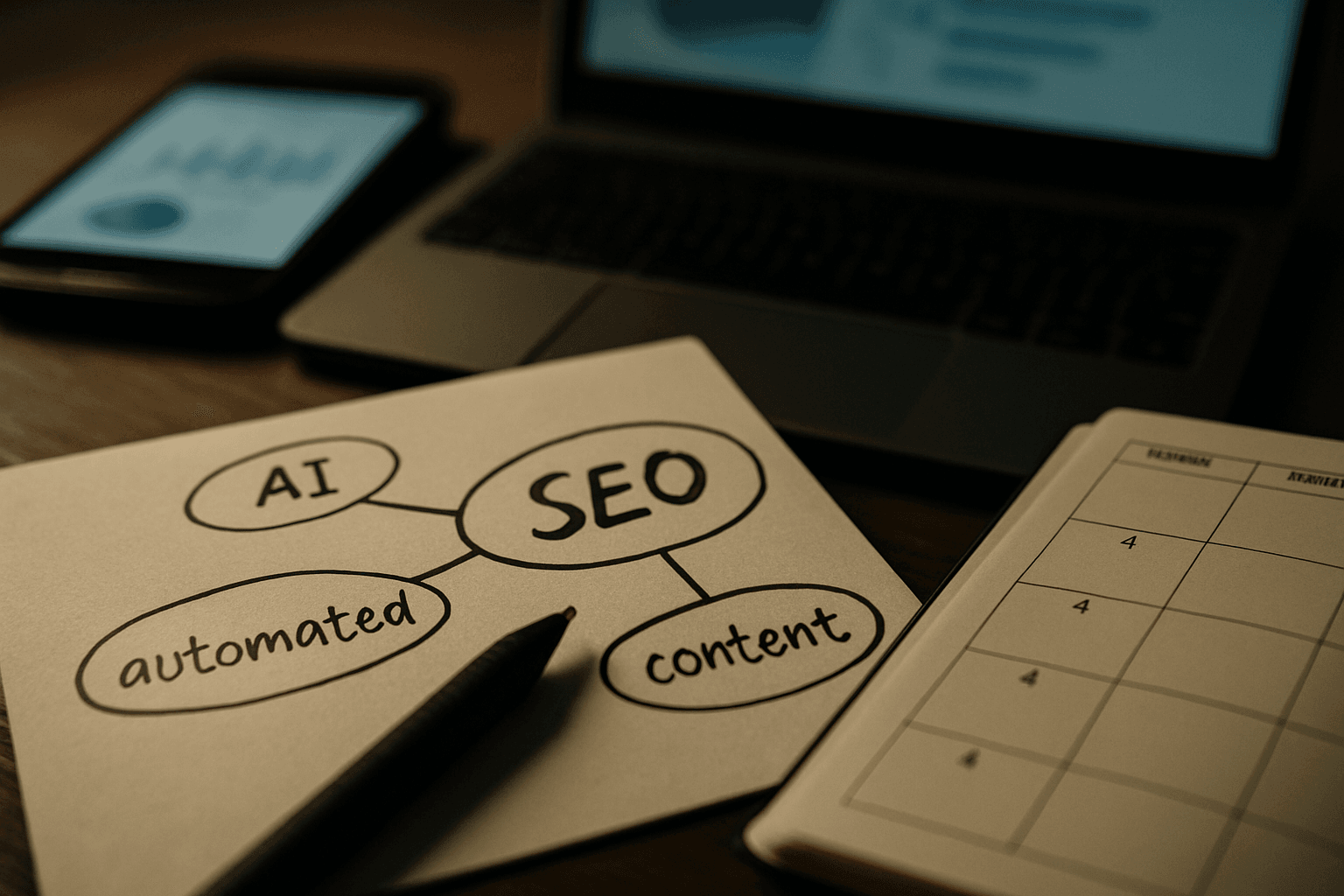
Week two shifts to strategy. This is where mind map SEO becomes invaluable. Instead of drowning in a spreadsheet of 500 random keywords, you visually map how topics connect. Start with your core service or product in the center, then branch out to customer questions, pain points, and related topics. For a local plumber, the center might be "emergency plumbing services." Branches include "burst pipe repair," "water heater installation," "drain cleaning," and "how to prevent frozen pipes." Each branch can split further into specific long-tail keywords. Mind map SEO lets you see content gaps and natural internal linking opportunities at a glance, something that's invisible in a flat keyword list.
Use AI-powered research tools to validate your mind map. Feed your topic clusters into tools that analyze search volume, competition, and user intent. According to LowFruits' DIY SEO guide, small businesses should focus on 5–10 core pages initially rather than trying to rank for everything. Pick keywords where page-one results include other small businesses or informational content, not just giant brands with massive budgets. A keyword like "commercial plumbing Los Angeles" might be too competitive, but "emergency pipe repair Pasadena" or "tankless water heater installation near me" could be realistic wins. By day 14, you should have a prioritized list of 10–15 target keywords and a rough content plan for the next two weeks.
Week 3: Content Creation and the Role of Automated SEO Software
Week three is where your research turns into actual pages that can rank. Start by auditing your existing content. Most small business sites have a homepage, an about page, a services or products page, and maybe a contact page. That's four pages, probably not enough. You need dedicated pages for each core service or product category, optimized for the specific keywords you identified in week two. If you're a dentist, you need separate pages for "teeth whitening," "dental implants," "emergency dental care," and "pediatric dentistry," not just one generic "services" page that tries to rank for everything.
Creating optimized content manually is time-consuming but straightforward. Each page needs a clear target keyword in the title tag (the clickable headline in search results), a compelling meta description (the preview text under the title), and an H1 heading that matches search intent. Use H2 and H3 subheadings to structure the content logically, and include the target keyword naturally in the first 100 words. XYZ Creative Works' DIY SEO guide emphasizes long-tail keywords here, phrases that are specific and less competitive. Instead of targeting "dentist," go for "affordable dental implants in Austin" or "same-day emergency dentist downtown."
This is where automated SEO software changes the game for SEO for Small Business. Manually researching search intent, outlining content, writing drafts, optimizing on-page elements, and formatting for readability takes 3–5 hours per page. Multiply that by ten pages, and you're looking at 30–50 hours of work, more than a full-time week. An SEO content generator that handles keyword clustering, generates E-E-A-T-optimized drafts, and auto-fills meta tags cuts that time by 70–80%. You still review and refine the output, AI can't replicate your unique business voice or insider expertise, but the heavy lifting is done. By day 21, you should have at least five core pages published or updated, each targeting a specific keyword and internally linked to related content.
Don't forget the technical on-page details. Every image needs descriptive alt text (good for accessibility and SEO), URLs should be short and keyword-rich (yoursite.com/emergency-plumber not yoursite.com/page-id-4782), and internal links should connect related pages. If your "burst pipe repair" page mentions water heaters, link to your "water heater installation" page. Google's fundamentals guide stresses that internal linking helps search engines understand your site structure and distributes ranking power across pages. Aim for at least 2–3 internal links per page, using descriptive anchor text like "learn about our drain cleaning services" instead of generic "click here."
Week 4: Local Dominance and Measuring Your Success
The final week focuses on local SEO and setting up systems to track progress. For any business serving a specific geographic area, restaurants, contractors, medical practices, retail stores, local SEO is your fastest path to revenue. Start by claiming and optimizing your Google Business Profile. This free listing appears in Google Maps and the local pack (the map and three business listings that show up for local searches). Fill out every field: business name, address, phone number, website, hours, categories, services, and a keyword-rich description. Upload high-quality photos of your location, products, or team. According to Webnode's DIY SEO guide, businesses should also list themselves on Bing Places, Apple Business Connect, and Yelp for broader visibility.
Consistency is critical for local SEO. Your business name, address, and phone number (NAP) must match exactly across all platforms. If your Google profile says "Main Street Plumbing LLC" but your Yelp page says "Main St Plumbing," search engines get confused and may not trust your data. Audit your listings and fix any discrepancies. This tedious task is worth it, local pack rankings heavily weight NAP consistency and citation accuracy. Spend day 22 and 23 on this; it's boring but pays off quickly.
Days 24 through 27 are for basic link building. You don't need hundreds of backlinks immediately, but a handful of quality links from relevant sources helps. Start with low-hanging fruit: ask suppliers, partners, or industry associations to link to your site from their resources page. If you sponsor a local event or charity, request a link from their site. Write a guest post for a local business blog or contribute expert quotes to journalists using services like HARO (Help a Reporter Out). The 30-day YouTube plan suggests simple cold outreach for backlinks, find sites linking to competitors, reach out with a personalized email explaining why your content is also valuable, and politely request a link. Keep it low-pressure and genuine; you're building relationships, not spamming.
The last three days of the month are for measurement and iteration. Log into Google Search Console and check which pages are getting impressions (showing up in search results) and clicks. Look for pages with high impressions but low click-through rates, that's a sign your title or meta description needs work. Check Google Analytics to see which pages visitors spend the most time on and which ones they leave immediately (high bounce rate). Set up rank tracking for your 10 core keywords using free tools like Serpfox or paid options like SEMrush. You won't see dramatic ranking changes in 30 days, but you'll establish a baseline. Understanding the SEO results timeline helps set realistic expectations, most sites see noticeable movement in 3–6 months, with compounding gains after that. Use your Free SEO Checklist to ensure you've completed all critical tasks.
By day 30, you've built a solid foundation: tracking is in place, core pages are optimized, local listings are claimed, and you've started building backlinks. More importantly, you have a repeatable system. Going forward, you'll spend a few hours per week creating or updating content, monitoring rankings, and refining what's working. The initial 30-day sprint is the hardest part; maintenance is far easier once the infrastructure is built.
Choosing Your Toolkit: Is SEO Siah Worth It for Small Business Owners?
The decision between manual SEO, hiring an agency, or using automated software boils down to three factors: time, budget, and control. Manual SEO costs nothing upfront but demands 10–20 hours per week and a steep learning curve. Traditional agencies deliver results but charge $2,000–$10,000 per month, pricing out most small businesses. Automated tools like SEO Siah sit in the middle, lower cost than agencies, far less time than manual work, and enough control to customize your SEO for Small Business strategy without needing a computer science degree.
SEO Siah's core value is end-to-end automation. You're not just getting a keyword research tool or a content generator, you're getting a system that handles the entire workflow from strategy to publication. The platform starts with mind-map-based planning, letting you visualize content clusters and internal linking opportunities. It then runs AI-powered keyword research, identifying low-competition targets your competitors might miss. Once you approve the strategy, it generates E-E-A-T-optimized long-form content, complete with proper heading structure, meta tags, and internal links. Finally, it publishes directly to WordPress or any CMS, eliminating the copy-paste step that wastes hours each week.
For business owners who want a "set it and forget it" system, SEO Siah offers fully automated growth. You input your business details, target locations, and core topics, then the platform builds a content calendar, generates articles, and publishes on schedule. You review the content if you want, but you don't have to, it's designed to run with minimal input. For SEO specialists or agencies managing multiple clients, the platform provides deeper control: advanced settings for tone, keyword density, content length, and custom prompts. Agencies benefit from bulk generation, consistent quality across clients, and the ability to scale from 5 clients to 50 without proportionally increasing headcount. The multi-tenant architecture means each client's data and strategy stay isolated and secure.
Comparing SEO Siah vs manual SEO services highlights where automation wins and where human expertise still matters. Manual SEO gives you complete creative control and the ability to inject brand personality into every sentence. If you're a copywriter by trade or your brand voice is highly distinctive, manual creation might be worth the time investment. However, manual SEO is slow, researching, outlining, writing, optimizing, and publishing one article takes 4–6 hours. Multiply that by the 20–50 articles you need for a robust content strategy, and you're looking at months of work. SEO Siah reduces that to days or weeks, freeing you to focus on client work, product development, or sales.
The pricing question matters. As of 2026, DIY SEO tools range from $50 per month for basic keyword research platforms to $500+ per month for comprehensive suites. SEO Siah's pricing sits in the mid-range, offering more automation than cheap tools and far lower cost than agencies. Most small businesses find the ROI positive within 3–6 months, if automated content generation saves 15 hours per week and your time is worth $50 per hour, that's $750 in weekly value, or $3,000 per month. Even if the tool costs $300 per month, you're ahead by $2,700. The calculation shifts if you're already outsourcing content creation to freelancers at $100–$200 per article; automation often matches or beats freelancer quality at a fraction of the cost.
The real question isn't whether SEO Siah or any automated tool is "worth it" in the abstract, it's whether it fits your specific situation. If you're a solopreneur with more time than money, starting with manual DIY SEO and free tools makes sense. If you're an established business with revenue but no time, automation pays for itself immediately. If you're an agency juggling ten clients and drowning in content requests, a platform that generates 50 articles per month with consistent quality is a competitive advantage. The key is matching the tool to your bottleneck. For most small businesses in 2026, the bottleneck is time and expertise, problems this DIY SEO guide addresses by showing you which tasks to automate and which require your personal touch.
One often-missed advantage of platforms like SEO Siah is the built-in best practices. When you generate content manually, it's easy to forget alt text on images, skip internal links, or write meta descriptions that are too long. Automated systems enforce standards, every article gets proper schema markup, every image gets descriptive alt text, every page includes 2–3 internal links to related content. That consistency compounds over time. Search engines reward sites with strong internal linking and technical hygiene, and automation ensures you never skip those details even when you're rushed. It's like having a Free SEO Checklist that auto-completes itself, eliminating the human error that often undermines DIY SEO efforts.
For agencies considering AI for SEO to scale operations, the calculus is even clearer. Hiring a full-time content writer costs $50,000–$70,000 per year plus benefits. That writer might produce 40–60 articles per month if they're fast. An automated platform can generate 200+ articles per month for a fraction of the cost, freeing your human writers to focus on high-value tasks like strategy, client communication, and editing. You're not replacing people, you're augmenting them, letting them manage more clients and deliver faster results. Agencies that adopt AI-powered workflows in 2026 can realistically handle 3–5x more clients with the same team size, a competitive edge that's hard to ignore.
The bottom line: SEO Siah and similar platforms are worth it if you value time over money, need consistent quality at scale, or want to focus on business growth rather than SEO mechanics. They're less ideal if you're a control-obsessed perfectionist who enjoys writing every word yourself, or if your budget is so tight that even $100 per month feels steep. For most small businesses and agencies, though, the ROI is obvious, faster results, lower overhead, and the ability to compete with much larger competitors who still rely on slow, manual processes.
Your 30-Day DIY SEO Setup Plan: Week-by-Week Breakdown
| Week | Focus Area | Key Tasks | Free Tools Needed | Time Commitment |
|---|---|---|---|---|
| Week 1 | Foundation & Tracking | Set up Google Analytics and Search Console; verify mobile-friendliness and HTTPS; create essential pages (Home, About, Contact) | Google Analytics, Google Search Console, PageSpeed Insights | 6-8 hours total |
| Week 2 | Keyword Research & Planning | Brainstorm customer questions; use Keyword Planner to find long-tail keywords; identify 5-10 priority pages to optimize | Google Ads Keyword Planner, Ahrefs free keyword generator | 5-7 hours total |
| Week 3 | On-Page Optimization | Optimize titles, meta descriptions, H1/H2 headings, URLs, and image alt text; add internal links; publish 1-2 blog posts | Built-in CMS tools, Google Search Console | 8-10 hours total |
| Week 4 | Local SEO & Link Building | Set up Google Business Profile, Bing Places, and Yelp; reach out to partners/suppliers for backlinks; establish ongoing maintenance routine | Google Business Profile, Bing Places, Apple Business Connect | 5-6 hours total |
| Beyond Day 30 | Ongoing Maintenance | Monitor rankings and traffic; publish new content monthly; update existing pages; respond to reviews | Rank tracking tools, Analytics, Search Console | 30-40 min/day or 3-4 hours/week |
Ready to Rank? Your 30 Days Start Now
Your DIY SEO guide doesn't need to be complicated, focus on the fundamentals we've covered, stick to the 30-day timeline, and you'll see your small business climb search rankings without hiring an agency. Most businesses that follow this structured approach notice their first page-one rankings within 90-120 days, especially for local and long-tail keywords where competition is manageable.
You've learned how to research keywords that actually convert, optimize your site's technical foundation, create content that answers real customer questions, and build local citations that Google trusts. That's not theory, it's the same process successful small businesses use in 2026 to compete against bigger competitors. The difference between businesses that succeed with SEO for Small Business and those that don't usually comes down to consistency, not budget.
Your next move is simple: pick your starting week from the guide and block out 60-90 minutes today to complete it. If you'd rather automate the heavy lifting, keyword research, content planning, and publishing, SEO Siah handles the entire workflow so you can focus on running your business while your rankings grow in the background. Grab the Free SEO Checklist to stay on track.
SEO isn't a one-month project. But after these 30 days, you'll have a system that keeps working, keeps ranking, and keeps bringing customers to your door.
Related Articles
- DIY SEO Software: Rank Your Small Business in 2026
- AI for SEO: Scale Your Agency to 10x More Clients
- SEO Results Timeline: 2026 Guide to Google Maps Success
- DIY SEO Tools: Best Cheap Software to Rank in 2026
- Mind Map SEO: How to Visualize Your Way to Page One
Frequently Asked Questions
Can I do SEO on my own without a huge budget?
Yes, you can absolutely do SEO on your own. In 2026, the barrier to entry for effective SEO for Small Business has dropped dramatically thanks to AI-powered platforms that handle the complex parts while you focus on running your business.
How to rank my website on Google fast?
To rank fast, focus on a 30-day SEO plan combining free tools like Google Search Console with systematic on-page optimization and local listings. Target long-tail keywords and optimize your Google Business Profile for local SEO, which is your fastest path to revenue.
Is automated SEO software worth it for small business owners?
Automated tools like SEO Siah sit in the middle, lower cost than agencies, far less time than manual work, and enough control to customize your strategy. Most small businesses find the ROI positive within 3–6 months. Use a Free SEO Checklist to track your progress and ensure you're hitting all the critical milestones.